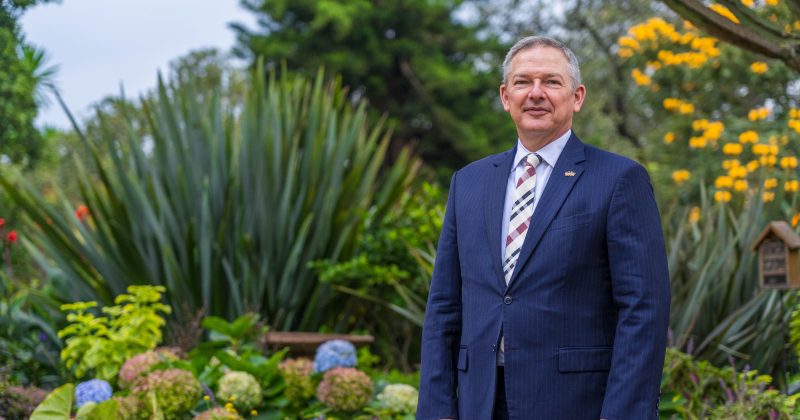
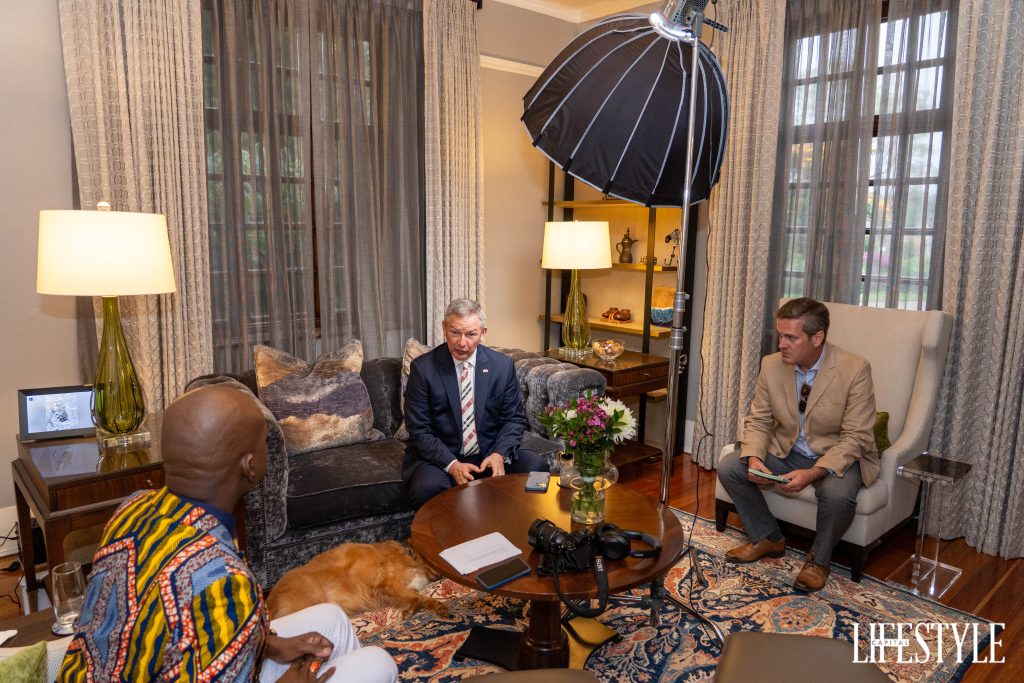
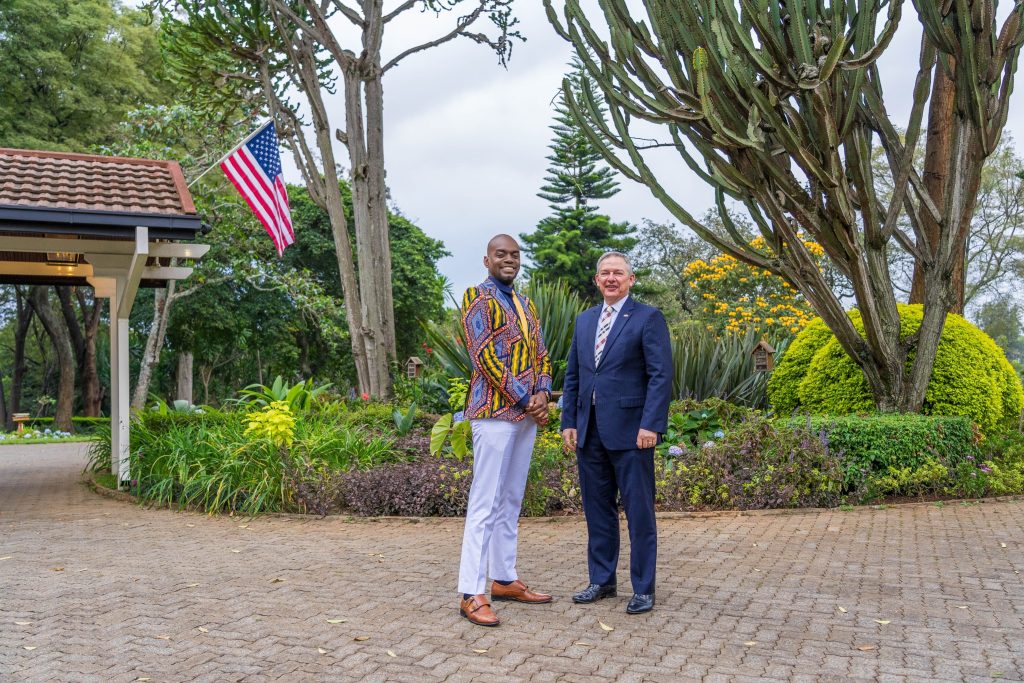
It’s just past 5 p.m. on a chilly Nairobi evening as we wind up the quiet, green drive to Tate House, the official residence of Marc Dillard, the US Chargé d’Affaires to Kenya.
Set in the leafy suburb of Spring Valley, Nairobi, the residence strikes a measured note: stately yet understated, diplomatic in function but softened by personal flourishes. Inside, we (my videographer, Charles, and photographer, Kristian and I) find Dillard already seated in the living room. He is punctual to the minute, a steaming cup of black tea in hand.
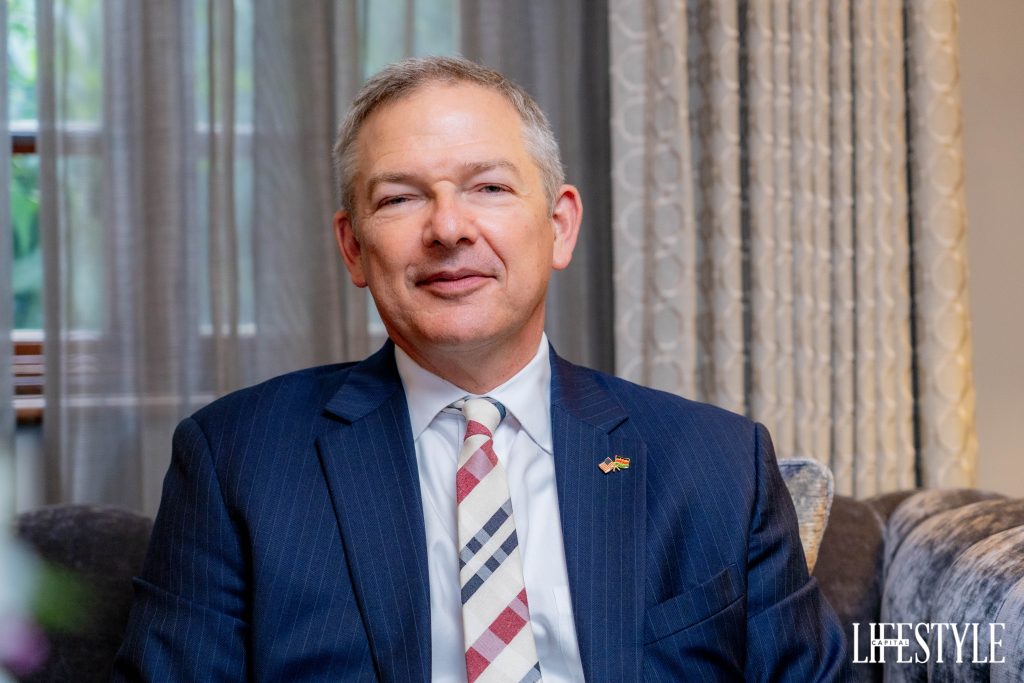
It is here that I’m about to record something unusual: Dillard’s first and only media interview in Kenya. And, fittingly, his last—an exit interview, just days before he departs the country.
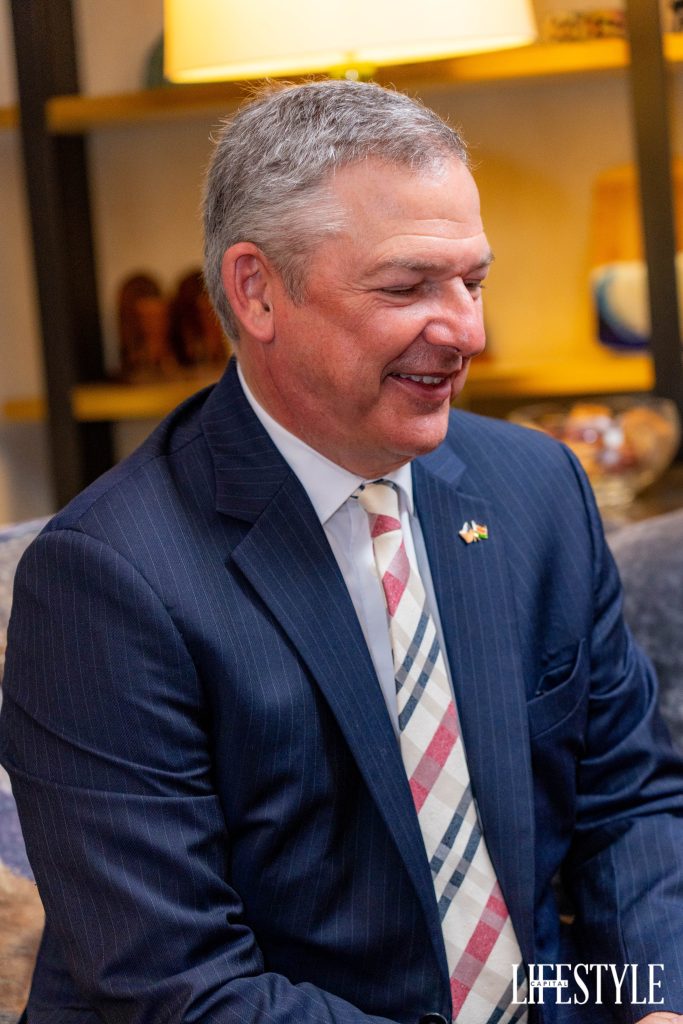
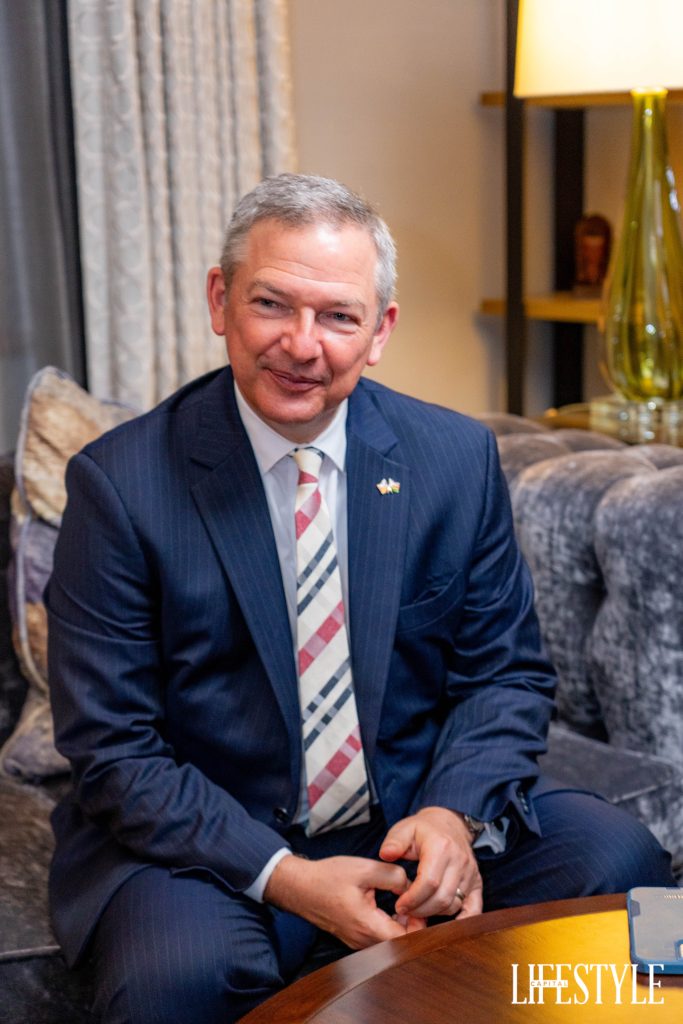
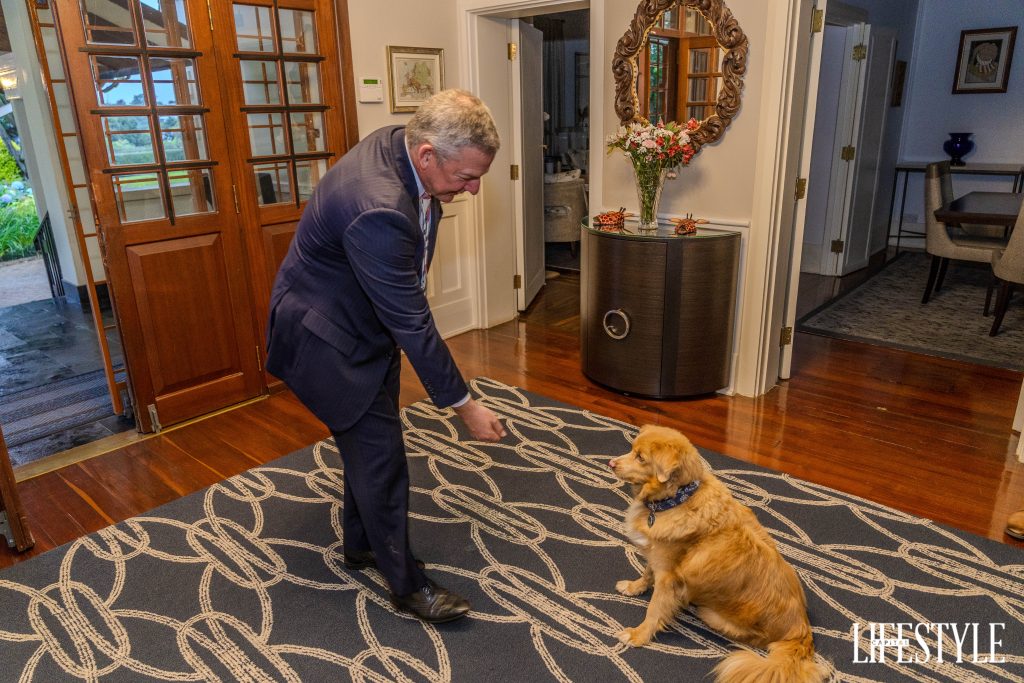
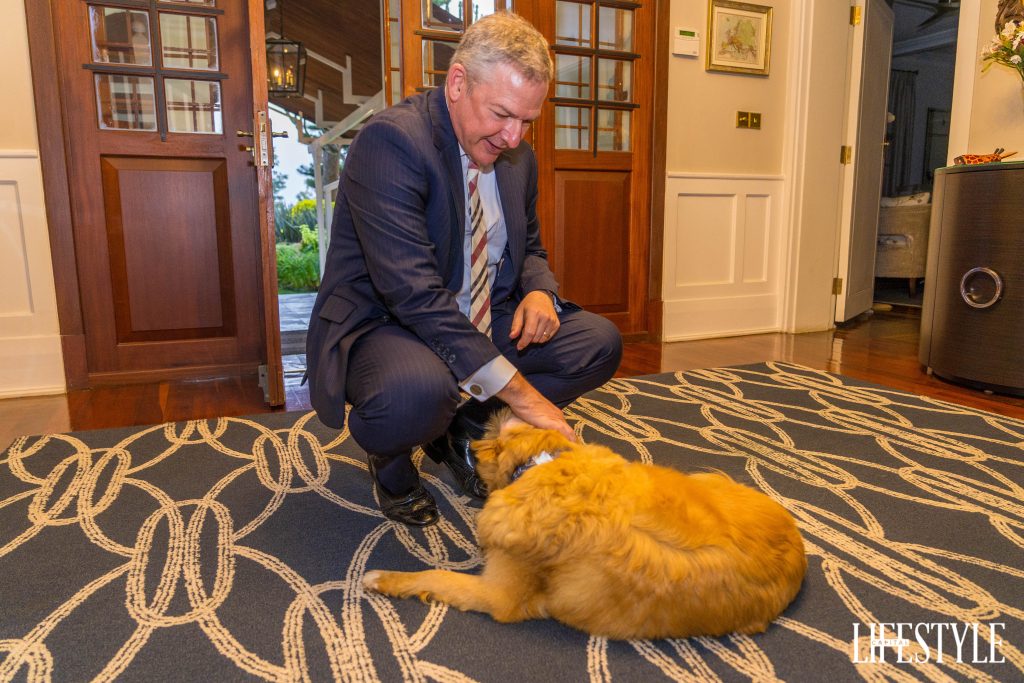
Dressed in a navy pinstripe suit, crisp white shirt, and a tie he casually mentions picking up in Tokyo, Dillard carries the look of quiet precision. His polished black shoes sound a muted echo across the wooden floor. Beside him sits Blaze, his brown dog, silent, watchful, and perhaps aware that something is ending.
Since August 2022, Marc Dillard has served as Deputy Chief of Mission at the U.S. Embassy in Nairobi. A career diplomat whose service began in 1998, he has held posts in Washington, Budapest, Sofia and Nairobi. He has also worked in Malawi, the Democratic Republic of the Congo, Japan, Korea, and as a Watch Officer/Senior Watch Officer in the State Department’s Operations Center.
His next assignment will take him to Pretoria, South Africa. But before he leaves, the diplomat allows himself one final, unguarded conversation, where diplomacy briefly steps aside for reflection. Stories are shared, laughter comes easily, and the atmosphere is relaxed. This isn’t merely a farewell.
25 questions on Capital Lifestyle and a few bonus ones because the conversation was that good
Personal Reflections, Values, and Leadership Philosophy
1. How would you describe or introduce yourself in three words?
One is thoughtful, another is honest, and the third is effective. I like to think that I try to do things intentionally with purpose and always grounded in principle. You know, our mums used to say, ’Honesty is the best policy,’ and I really believe that honesty is the foundation of any meaningful relationship. And I’m very interested in being effective as a human being. We’re here, hopefully, to make a difference. I’d rather be effective than just… make noise.
2. Would you say you’re an introvert or extrovert?
I’m a mild extrovert.
3. What’s the best leadership advice you’ve ever received?
In the mid-90s, I had a chance to work with a leadership thinker named Warren Bennis. He had this phrase he used to repeat: “Managers do things right; leaders do the right things.”
As I’ve moved through my career in both management and leadership roles, that quote has stayed with me. As a manager, I learned to do many things well but as a leader, the question shifts. It becomes: What are the right things to do?
At a strategic level, especially within embassy work, you have to identify which actions will have the most impact. But there’s also a moral and ethical side to that question. When decisions get tough, Warren’s phrase reminds me to pause and ask: What is the right thing to do?
4. What initially inspired you to pursue a career in diplomacy?
As a student, I spent some time in Vienna in 1987 with a wind band. It was my first time traveling outside the U.S., and I discovered I had a real ability to connect with and understand people from different cultures. Some of my peers struggled with those cross-cultural interactions, but I found them intuitive and meaningful. Eventually, I realized that this was a skill and I wanted to find a profession that valued it. That’s how I found my way to diplomacy and the U.S. State Department.
5. How many years have you been in the U.S. State Department?
I joined in 1998 so I’m just about to hit 27 years.
6. What’s one item or souvenir you always collect from every country you’ve lived in?
I don’t have a fixed collection or theme, but my wife and I try to find at least one meaningful piece from every place we’ve lived something that evokes a memory.
For instance, when we lived in Malawi, we bought a carved chest made from Mulanje cedar, a tree species indigenous to Malawi. In Japan, we were gifted a beautiful red kimono by close friends. Here in Kenya, we plan to take home some art from Kitengela Glass, something that will always remind us of our time here.
7. What has surprised you most about Kenya since moving here?
The variety. Kenya is such a country of contrasts. I recently traveled to Garissa, which has both arid and semi-arid regions. Then there’s Mount Kenya, which has a completely different climate and landscape.
Culturally, the Coast feels distinct from Nairobi, and Nairobi feels different from Kisumu. Even just walking around Nairobi, you can see the diversity: it’s a real mix, and that’s been both surprising and exciting.
8. Of all your global postings, which one surprised you most whether culturally or in the rhythm of daily life?
Day to day life? It would have to be Japan. Japan has its own distinct aesthetic. Living in Tokyo with its millions of people coexisting in such a highly organized and efficient way. It was fascinating.
The art scene there is deeply rooted in history, and it’s quite different from what you’d find in the U.S., Europe, or Africa. Of all my postings, Japan felt the most culturally distinct.
Career Journey, Global Experiences, and Proudest Moments
9. If you could sit down with any historical figure, who would it be and why?
I’d choose Thomas Jefferson. He was a U.S. President, Secretary of State, and an Ambassador to France, so he had a remarkable diplomatic career. He also drafted the Declaration of Independence, an incredibly foundational document.
I think there’s so much to learn from him about diplomacy, leadership, and the founding of the United States.
10. What has been the proudest moment of your diplomatic career so far?
Being a diplomat gives you access or entrée, if you will, to some truly incredible experiences. Like sitting here with you today.
I’ve had the chance to travel across this beautiful country, and I’ve also been in situations where we’ve helped American citizens in distress like after a car accident, or in legal trouble. In those moments, you realize you’ve made a real difference in someone’s life, and that’s incredibly rewarding.
But I’d say the most sustained period I’ve felt proud was when I served as Chargé d’Affaires during COVID at my previous posting. Leading a community through such a challenging time when people were concerned for their health, their families, and their future—was incredibly demanding.
But being useful and helpful during that crisis was one of the most fulfilling parts of my career.
Discovering Kenya, Observations, and Cultural Surprises
11. If someone were visiting Kenya for the first time, which three places would you recommend they explore?
Absolutely. I’ve had lots of family and friends come visit: my father, my stepsister, cousins, my wife’s cousins, even old college friends so I’ve had to answer this question many times!
First, I always recommend the Maasai Mara. It’s such a unique and special place in the world if you’re an international visitor to Kenya, the Mara is a must.
Second, I encourage people to spend time in Nairobi. Many Americans have media-driven perceptions of Africa that don’t always match the reality. Nairobi surprises them with its skyscrapers, vibrant neighborhoods, and places like Nairobi Street Kitchen and all these fascinating restaurants.
Then, depending on the person: if they’re more outdoorsy or into hiking, I’ll recommend Central Kenya. If they’re beach lovers, I’ll send them to the Coast.
12. What Kenyan habit or phrase have you picked up that you might carry with you to your next post?
‘Is it?’ I hear that all the time, and I’ve already started saying it myself!
Also, there’s a uniquely Kenyan word I hadn’t heard before—bitings. I find it so charming and homey. It instantly makes you feel welcome.
13. Where do you see the biggest opportunities for growth between Kenya and the U.S.?
There are several strong areas:
First, agriculture. A large number of Kenyans work in this sector, and the U.S. has world-leading agricultural technology and practices. We’re now even using big data to determine what crops to grow and where. There’s a win-win opportunity here. U.S. companies can offer solutions that increase productivity for Kenyan farmers, which benefits both countries.
Second, the Silicon Savannah. Kenya has amazing tech talent coming out of its universities, and there are opportunities to link that with expertise and investment from Silicon Valley, Boston, Chicago, L.A., and beyond. It’s a promising area for innovation and collaboration.
Third, the Kenyan creative economy. We recently hosted a Creative Economy Forum. There’s so much potential here from storytelling and music to film and fashion. Kenyan voices are already starting to show up globally, on platforms like Netflix and in international music. I think we’re just getting started.
14. Are you a good cook? If so, what would be the ideal meal you’d prepare for a first-time visitor to your home?
I’m not a bad cook! I haven’t done much cooking in Kenya, but within my family, I’m definitely the grill master. They always want me at the grill because I can get the meat or fish just right.
If you were visiting my home for the first time, I’d want to make something personal and something that showcases a bit of the U.S. I’d prepare a grilled salmon fillet, using a recipe I got from my father. It’s marinated in lemon, Worcestershire sauce, mustard, and a touch of Tabasco for a bit of zing.
I’d serve that with wild rice which has a nice nutty flavor and grilled asparagus tossed in olive oil and salt. And to finish it off, I’d pair it with a glass of Pinot Noir.
On Kenya–U.S. Relations, Economic Opportunities, and Innovation
15. There’s always strong demand among young Kenyans who want to study or travel to the U.S. What advice would you give to applicants pursuing opportunities there?
We love seeing people take advantage of educational opportunities in the U.S. My advice? Do your homework.
One of the great strengths of the American university system is its diversity. There are thousands of institutions, some are focused on the Great Books and classical education, others are polytechnic or engineering schools like the ones my kids attended, and some blend academic theory with practical experience, where students alternate between classroom learning and working in real-world companies.
So the real question is: Which university is the right one for you? Everyone has a different learning style, and the U.S. offers a wide range of options to match that.
When it comes time for your visa interview, the most important thing is to be clear and specific. Explain why you want to attend that particular school, what you want to study, and how it fits into your broader goals. When your story hangs together and makes sense, it shows you’ve thought it through.
And of course, it’s crucial to respect and follow the visa rules, that’s the foundation for everything going smoothly.
16. How do you view the role of Kenyan youth in shaping political conversations especially with the bold, vocal Gen Z community on social media?
Kenyan youth have a vital voice. Given the country’s young population, it’s significant that about a million young Kenyans graduate each year either from high school or college and enter the workforce. That’s powerful.
We’ve clearly seen, especially in recent protests and demonstrations, that this generation is passionate and engaged. They care deeply about the issues that affect their future.
What I’m watching and what I think is the next step is how this generation matures politically. Right now, a lot of the energy is channeled through social media. But to truly effect change and be effective, back to that first question about leadership. You need to transform that passion into action: into policies, into programs, into a political agenda.
The key question now is: How do you channel your voice into the system in a way that builds momentum, gains support, and leads to real, tangible change?
17. Are there lessons Kenyan youth can learn from young people in the U.S.?
Absolutely. Looking back at U.S. history, particularly in the 1960s, there were powerful youth-led movements around decolonization, civil rights, and racial equality.
What stood out then was the use of peaceful, nonviolent protest to elevate issues and push for change. I think that’s a model worth looking at—how to bring your cause into the political space constructively and effectively. The strategy and discipline behind those movements can offer inspiration.
Food, Family & Everyday Joys
18. What’s been your most memorable family adventure in Kenya: a safari, beach escape, or cultural experience?
Definitely safari. My kids are university-aged now, so they only visit during holidays. One year, we took them on safari and it was absolutely spectacular. Another time, we took them to the Coast to explore Kenya’s marine life, which was just as magical.
Kenya is famous for its land safaris, but it’s also an Indian Ocean country and the sea experiences are equally breathtaking. We had a wonderful time.
19. Has your family picked up any Kenyan tastes or habits: maybe a love for chapati, nyama choma, or even some Swahili?
Well, I don’t know anyone who comes to Kenya and doesn’t fall in love with nyama choma!
Personally, I’ve developed a taste for mukimo. It reminds me of mashed potatoes from back home, but with some added ingredients that give it a uniquely Kenyan twist. I really enjoy it.
20. You’re a dog dad. What breed is your dog, and how would you describe his personality in one word?
Yes, I’m a proud dog dad! My dog is called Blaze. He’s a Nova Scotia Duck Tolling Retriever or just a Toller for short.
He’s a retriever, about half the size of a golden retriever, with the same friendly, gentle nature. He’s smart, calm, and incredibly sweet.
Here in Kenya, I think Blaze would say his favorite thing has been bird watching, literally! We’re lucky to have some lawn space, and he’s always chasing the many birds that come and go. That’s how he keeps himself entertained.
Books, Creativity & Final Reflections
21. What’s your ultimate guilty pleasure: a TV show, a snack, or a hobby?
When I really want to unwind, my wife and I love watching reruns of old comedies from the ’90s. It’s nostalgic, comforting, and just plain fun.
22. If you had a full day off with zero work emails, how would you spend it?
If I had one of those golden days with no interruptions, I’d definitely want to do something active: maybe a jog or a workout.
And then, honestly? I’d spend the rest of the day reading. I’m a compulsive reader. Give me a good novel, let me sit outside with it, and I’ll be perfectly content for hours.
23. Any book you would recommend for me?
What genre do you enjoy?
(Interviewer: I love autobiographies.)
Great! Right now, I’m reading an autobiography of George H. W. Bush. I also recommend anything by George J. Mitchell—he’s written excellent political memoirs, especially focused on U.S. Presidents.
If you enjoy that genre, there’s a lot of depth and insight in those works.
24. If you were to take a piece of the Kenyan creative economy, whether fashion, art, music, or literature to another part of the world, what would it be?
Art.
We’re planning to take with us a piece of Kenyan art from Kitengela Glass. It’s beautiful and meaningful, and it will travel with us to our next destination, South Africa. It’ll be a special reminder of our time here.
25. What advice would you give to young creatives in Kenya who are hoping to position themselves for international opportunities?
Two key things:
First, work really, really hard. There’s so much talent in Kenya, but remember that today’s creative world is a global stage. Thanks to technology, you’re no longer just competing locally. You have to bring something fresh, unique, and competitive on a global level.
Second, understand the business side. That’s one of the reasons we hosted the Creative Economy Forum. For creatives who want to turn their passion into a livelihood, it’s crucial to think about monetization and sustainability. Ask yourself: How do I get rewarded for what I create? What model works for me?
Success in the creative economy means blending talent and business acumen—you need both to thrive.
26. If you could leave one message for Kenyans as your term comes to an end, what would that be?
I’ve been deeply impressed by what I’ve seen in Kenya: the people, the institutions, and the remarkable potential.
In light of recent events and political moments, I would encourage Kenyans especially the youth, to continue raising their voices. But do so peacefully. Non violence matters.
Channel that passion into building and advancing institutions. Kenya has long held a leadership role in this region, and you can’t spend time here without being struck by how much more this country can achieve. The future is bright, just keep working toward it constructively.
27. If you could leave one message or piece of advice for your team at the U.S. Embassy as you exit Kenya, what would it be?
Keep walking alongside Kenya on its journey.
The Kenya of today is very different from the Kenya of the 1990s. It has evolved and so has our partnership. My advice to the team is: Keep finding the ways in which the U.S. Embassy can be helpful.
That’s how we continue to strengthen this relationship, a relationship that has already been so productive and meaningful over the past several decades. Let’s keep building on that foundation.
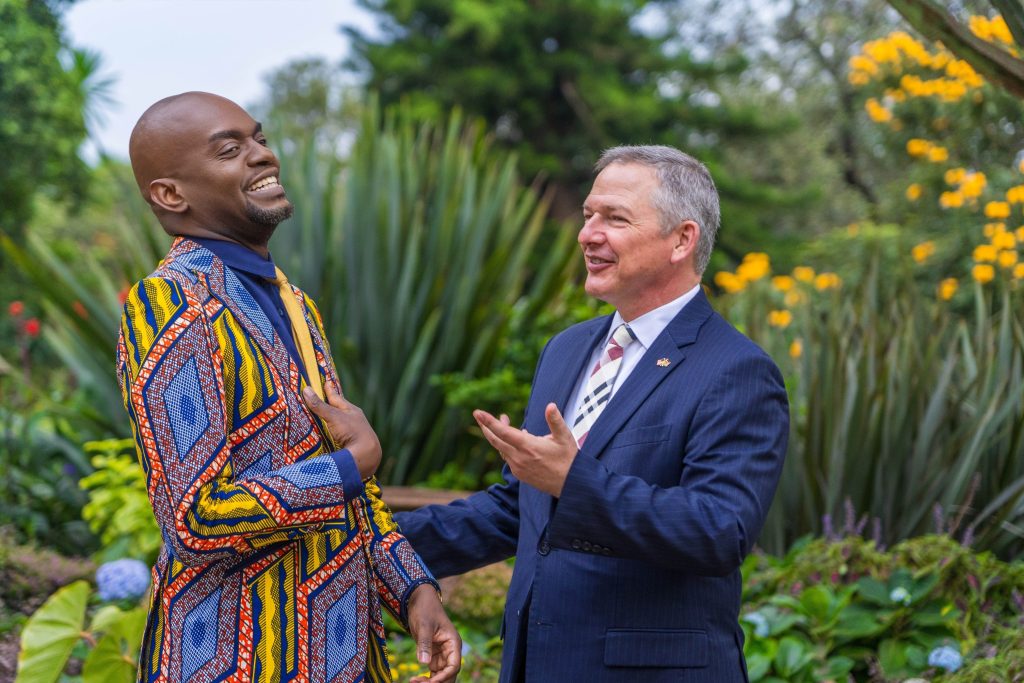
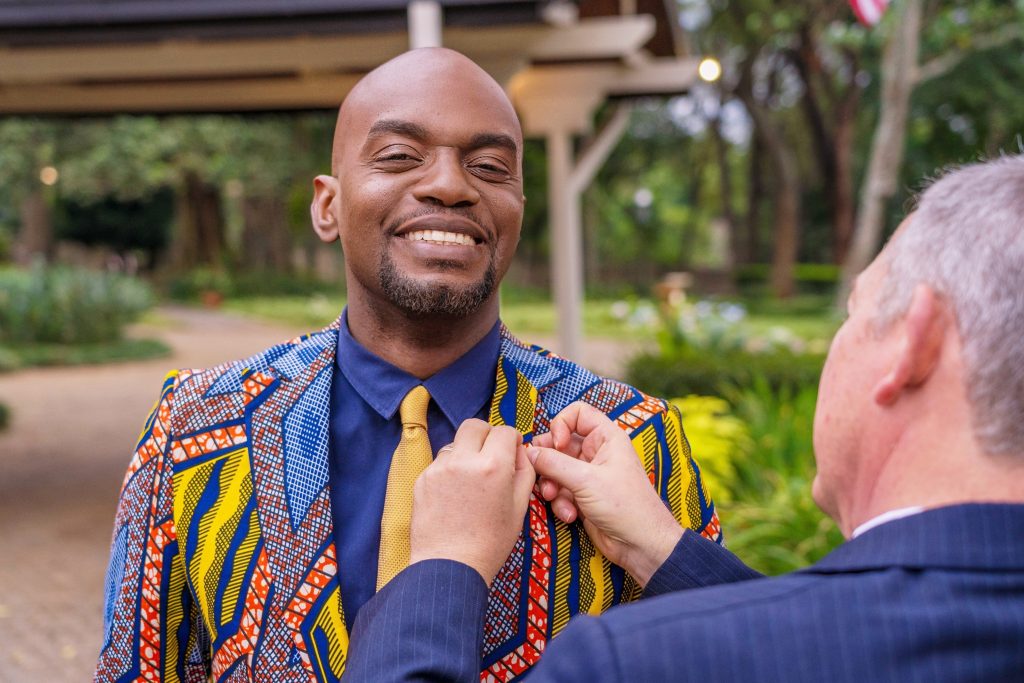
(@USAmbKenya on X / U.S.EmbassyNairobi/ on Facebook )