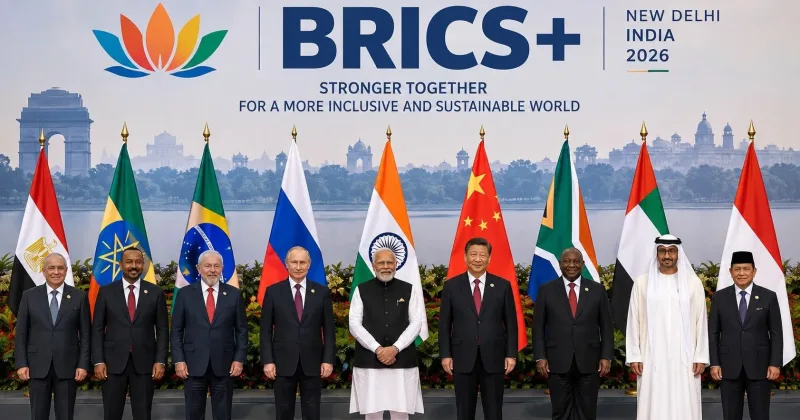
Sep 13 – BRICS is no longer the compact five-member forum that India helped build around the politics of emerging economies. Its enlargement has given the grouping a much broader geographic reach, greater demographic and economic weight, and a stronger claim to represent dissatisfaction with the existing international order.
But expansion has also introduced more contradictions into a grouping that was never particularly cohesive to begin with.
For India, the significance of BRICS+ goes well beyond the outcome of the New Delhi summit. The expanded bloc offers New Delhi what the original BRICS could not: a wider Global South constituency. At the same time, it presents India with a far more complicated exercise in coalition management.
India must deepen relations with the UAE and other pragmatic middle powers while engaging newer members without allowing continued expansion to hollow out the grouping. The New Delhi summit is therefore important less as a destination than as the beginning of a larger test for Indian foreign policy: how to make BRICS+ serve India’s multipolar strategy without allowing the grouping to define that strategy.
Bigger BRICS, bigger opportunity?
There are good reasons why enlargement could work in India’s favour.
The original BRICS provided India with an unusual diplomatic space. An enlarged BRICS now connects India more systematically with important states across the Middle East, Africa, Asia and the wider Global South.
BRICS+ can amplify India’s preferred vocabulary: strategic autonomy, multipolarity, sovereign equality, reformed multilateralism and greater representation for developing countries.
There is an important distinction here. India does not need BRICS to replace the international order. It needs BRICS to increase its bargaining power within that order.
The enlarged grouping strengthens India’s case for reforming international institutions whose structures do not adequately reflect today’s economic and demographic realities. It also provides a platform for India’s Global South diplomacy on development financing, climate justice, technology access, food and energy security, resilient supply chains and digital public infrastructure.
The UAE, for instance, represents a form of strategic pragmatism closer to India’s own preference for diversified partnerships than to bloc politics. Indonesia brings another major Asian power deeply committed to strategic autonomy. Egypt, Ethiopia and other members bring distinct regional priorities.
The new members make India’s balancing act more complex, but they also create new political opportunities for New Delhi.
The NDB: development bank or geopolitical bank?
Nowhere is the contest over BRICS’ purpose more consequential than in the New Development Bank (NDB).
The NDB remains arguably the grouping’s most important institutional achievement. As of the end of the first quarter of 2026, the bank had approved $42.9 billion in financing for 140 projects across sectors including clean energy, transport, water and sanitation, environmental protection, and social and digital infrastructure.
India has been among its largest beneficiaries. The bank said in March 2026 that it had committed nearly $10 billion to 32 Indian projects.
Yet the politics surrounding the NDB reflect a deeper disagreement over what BRICS should become.
India should favour a different trajectory. New Delhi’s objective should be to strengthen the NDB as a development institution rather than turn it into a geopolitical instrument.
India has much to gain from local-currency financing. The NDB and Indian authorities are advancing a rupee-denominated bond programme expected to mobilise about INR 250 billion over five years. India’s Department of Economic Affairs has also emphasised rupee and yen financing and the development of local-currency operations as the bank prepares its 2027–31 strategy.
These developments represent financial diversification with practical development objectives: reducing exchange-rate risk, mobilising domestic capital and financing infrastructure.
The same distinction should inform India’s approach to BRICS payment systems.
Beyond the New Delhi summit
The New Delhi summit provides India with an opportunity to articulate this broader vision. But India’s success should not be measured by the length of the Delhi Declaration, another round of expansion or the number of initiatives announced at the summit.
It should be measured by whether India can begin shifting BRICS from enlargement to consolidation.
India does not necessarily need a continuously expanding BRICS. Enlargement has already given the grouping considerable geopolitical weight. What it lacks is coherence.
Further expansion without clear criteria risks transforming BRICS into an amorphous Global South assembly: large enough to attract global attention but too unwieldy to make meaningful decisions.
India therefore has an interest in preserving a distinction between full members, partner countries and outreach mechanisms, rather than assuming every interested state should eventually become a full member.
New Delhi should approach BRICS+ neither as its principal foreign policy platform nor as an inconvenient legacy grouping. It should treat it as one pillar of a wider strategy: building multipolarity without embracing bloc politics.
That is the real significance of the New Delhi summit. Delhi can demonstrate India’s chairmanship; what follows will demonstrate its statecraft.
The central question, then, is not whether BRICS+ is stronger than the old BRICS. It is whether India can make a larger and more contradictory grouping work in favour of a multipolar order while preserving its strategic autonomy.