
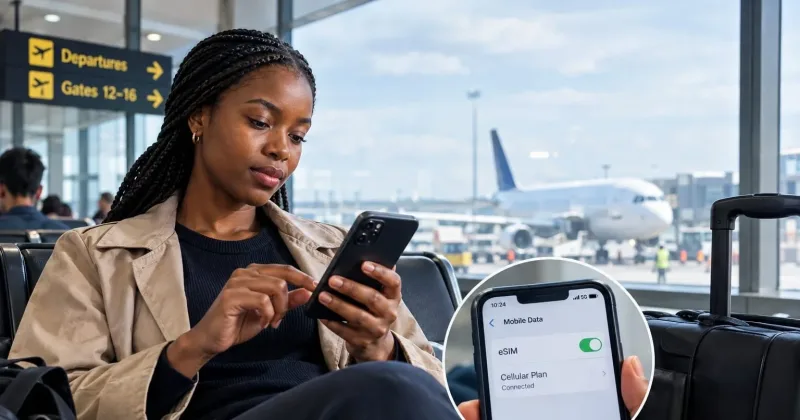
NAIROBI, Kenya, Sept 14 – International travellers moving between multiple countries are increasingly looking for simpler ways to stay connected as conventional roaming services, physical SIM cards and different mobile networks add costs and inconvenience to multi-destination trips.
The challenge is particularly common among tourists, business travellers and frequent flyers whose itineraries involve several countries. Under traditional arrangements, travellers may have to purchase local SIM cards or activate different roaming packages each time they cross a border.
The growth of eSIM technology is changing the way international connectivity is delivered by allowing users to download mobile network profiles directly onto compatible smartphones without physically replacing a SIM card.
Regional eSIM packages have further simplified connectivity for multi-country travellers by allowing a single data plan to work across several destinations.
Kwetu eSIM, for example, says its coverage extends to more than 200 destinations, with regional packages available across Europe, Asia, Latin America and the Balkans.
A traveller moving from Italy to Croatia, for instance, can use a regional plan covering both countries without having to purchase another physical SIM or install a separate eSIM after crossing the border.
The digital nature of eSIMs also allows travellers to arrange connectivity before departure. Once they reach a supported destination, the eSIM can connect to an available partner network, reducing the need to search for a local provider after landing.
Kwetu eSIM currently offers regional packages including Europe+, covering 36 destinations, Asia with 17 destinations, Latin America with 12 destinations and the Balkans with 12 destinations.
The expansion of smartphones supporting multiple SIM and eSIM profiles has also made the technology more practical for international travellers. Users can retain their regular home mobile line while using an eSIM primarily for data when abroad.
Travellers can install the eSIM before departure and activate it when they reach a supported destination, potentially avoiding queues at airport SIM-card shops and the need to find a local provider immediately after landing.
However, eSIM users still need to check whether their devices support the technology and whether all the countries on their itinerary are covered by the selected package.
Data allowance, validity period, pricing and network availability are also important considerations when choosing a plan.
Another feature offered by some eSIM providers is the ability to top up an existing profile. Travellers who run out of data during a trip can purchase additional data without necessarily installing a new eSIM.
The shift towards digital connectivity reflects a broader change in international travel, with travellers increasingly able to arrange mobile services before leaving home rather than waiting until they arrive at their destination.
For people travelling across several countries, regional eSIMs offer a way to maintain mobile data connectivity across supported networks without repeatedly changing SIM cards.
As multi-destination travel grows, the technology could make staying connected across borders less dependent on physical SIM cards, airport purchases and traditional roaming packages.