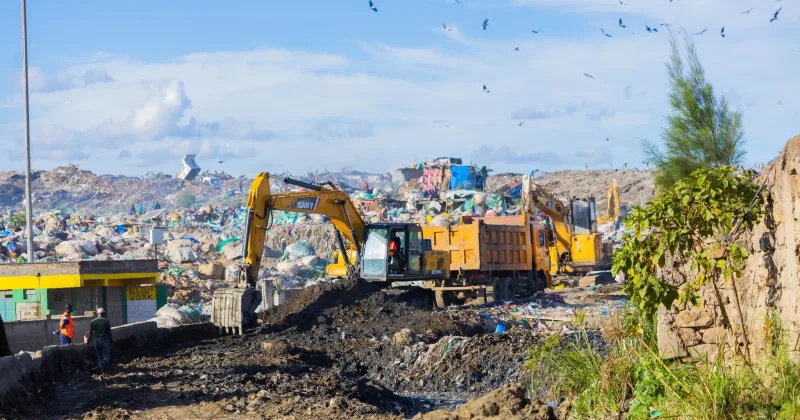
NAIROBI, Kenya, Aug 12-For years, Simon Kuria has read Dandora dumpsite like a map.
He knows where plastic bottles accumulate after a delivery, which trucks carry scrap metal worth following and which sections of the sprawling site offer the best chance of finding something he can sell.
The work has kept him away from crime and helped feed his family.
But it has never come with a contract, insurance or pay slip.
So, when excavators arrived to reshape the dumpsite, Kuria initially feared the cleanup would take away his livelihood.
“We thought they were taking away our jobs,” he said.
Today, his fear has given way to a more complicated reality.
He welcomes the cleaner sections of Dandora but worries that as Nairobi moves to rehabilitate the dumpsite, there will be less usable waste left for thousands of informal workers who have built their livelihoods around it.
That tension is emerging as the biggest test of Nairobi’s ambitious waste-management overhaul: how to clean up Dandora without leaving behind the people whose livelihoods depend on the waste.
Dandora receives an estimated 2,000 to 3,000 tonnes of waste every day, more than three times the volume the site was designed to handle when it opened in 1975.
For decades, an informal economy has grown around the waste stream, linking pickers to scrap dealers, transporters, storage facilities and recycling markets.
Estimates of the workforce vary from about 3,000 families to as many as 8,000 individual waste pickers on a given day.
A recent survey by the Nairobi Recyclable Waste Association found that 71 percent of waste pickers reported work-related health problems.
Dorcas Ligawa, who has spent four and a half years picking plastics and scrap at Dandora, knows the risks firsthand.
“There are days you go home with cuts all over your hands,” she said.
Health burden
Some pickers receive gloves and gumboots, but protective equipment does not reach everyone. When Ligawa suffers a serious injury, she pays for treatment herself before returning to the dumpsite.
The health burden has also extended beyond injuries.
At Dandora One Health Centre, counsellor Mary Riungu says respiratory illnesses account for more than 100 cases a week, with smoke from waste burned inside the dumpsite a major contributor.
The environmental damage has been equally severe.
In February, Kenya’s Environment and Land Court ruled that more than 1,000 waste pickers had been exposed to hazardous conditions and years of pollution.
The court ordered compensation of Sh25,000 for each affected worker, marking a significant legal recognition of the harm endured by a workforce that has operated largely outside the formal waste-management system.
But rehabilitation could create another problem if the social and economic structures around Dandora are not addressed.
Sociologist Fabrizio Floris, who has spent months studying Dandora’s informal economy, argues that shutting down or rehabilitating the dumpsite is only the beginning.
The physical site can be closed. The economy built around it cannot simply disappear.
For years, waste pickers have created their own systems of sorting, collection, storage, transportation and resale.
Those networks have provided income for thousands of people despite operating without formal recognition.
That is why youth leader Kennedy Kariuki is calling for waste pickers to be included in Nairobi’s rehabilitation plans.
“We need to start having inclusive rehabilitation,” he said.
Without such inclusion, he warns, the city could end up reproducing Dandora’s problems elsewhere, only under a different name.
The responsibility now falls partly on Zoomlion, a Ghanaian firm under the Jospong Group, which has taken over a 20-year contract to manage Nairobi’s solid waste system, including Dandora.
Nairobi Governor Johnson Sakaja awarded the contract as the county seeks to overhaul waste collection, disposal and recovery across the capital.
The tender attracted only one bidder, a detail that has prompted legal challenges and political scrutiny.
Zoomlion officials say they inherited about 109 illegal dumpsites and have begun clearing them, with 24-hour operations and improved access roads forming part of the cleanup.
At Dandora, engineer Daniel Asante, who is involved in reshaping Site 41, says the immediate priority has been bringing order to a chaotic dumping operation.
“When we arrived, traffic inside the dumpsite was chaotic,” he said, describing trucks that previously waited for hours before unloading.
His team has since constructed access roads and tipping platforms to improve the movement of waste trucks.
Informal pickers
But the rehabilitation raises a crucial question: where do the waste pickers fit into the new system?
Asante says recycling was not part of his rehabilitation brief and maintains that the informal pickers operate independently of the county contract.
He said engineers have told the pickers that their work would continue undisturbed.
The long-term plan, however, is to move formal sorting and recovery into purpose-built facilities.
A resource recovery plant at Ruai, designed to process 3,500 tonnes of waste a day, is expected to open by the end of November.
Asante says a planned recycling and composting facility at Ruai will eventually provide a formal setting for waste recovery, separate from the informal sorting economy that has developed at Dandora.
For Zoomlion, the transformation is being presented as more than a cleanup operation.
“It is about protecting lives, restoring productivity, and investing in the future of Nairobi,” said Peter Dagadu, the company’s director of operations in Kenya, during cleanup operations in Ruaraka in May.
Dagadu said early signs of improvement were already visible, with cleared spaces beginning to reopen for small-scale economic activity.
But for Kuria and Ligawa, the measure of success will be more personal.
A cleaner Dandora matters. So does knowing whether the people who survived for years by sorting its waste will have a place in the economy that replaces it.
Kenya’s environmental authorities have warned that rehabilitation itself must be carefully managed.
Proper closure requires more than removing waste and clearing land; it involves managing leachate and monitoring groundwater long after construction is complete.
The same principle may apply to the people who depend on Dandora.