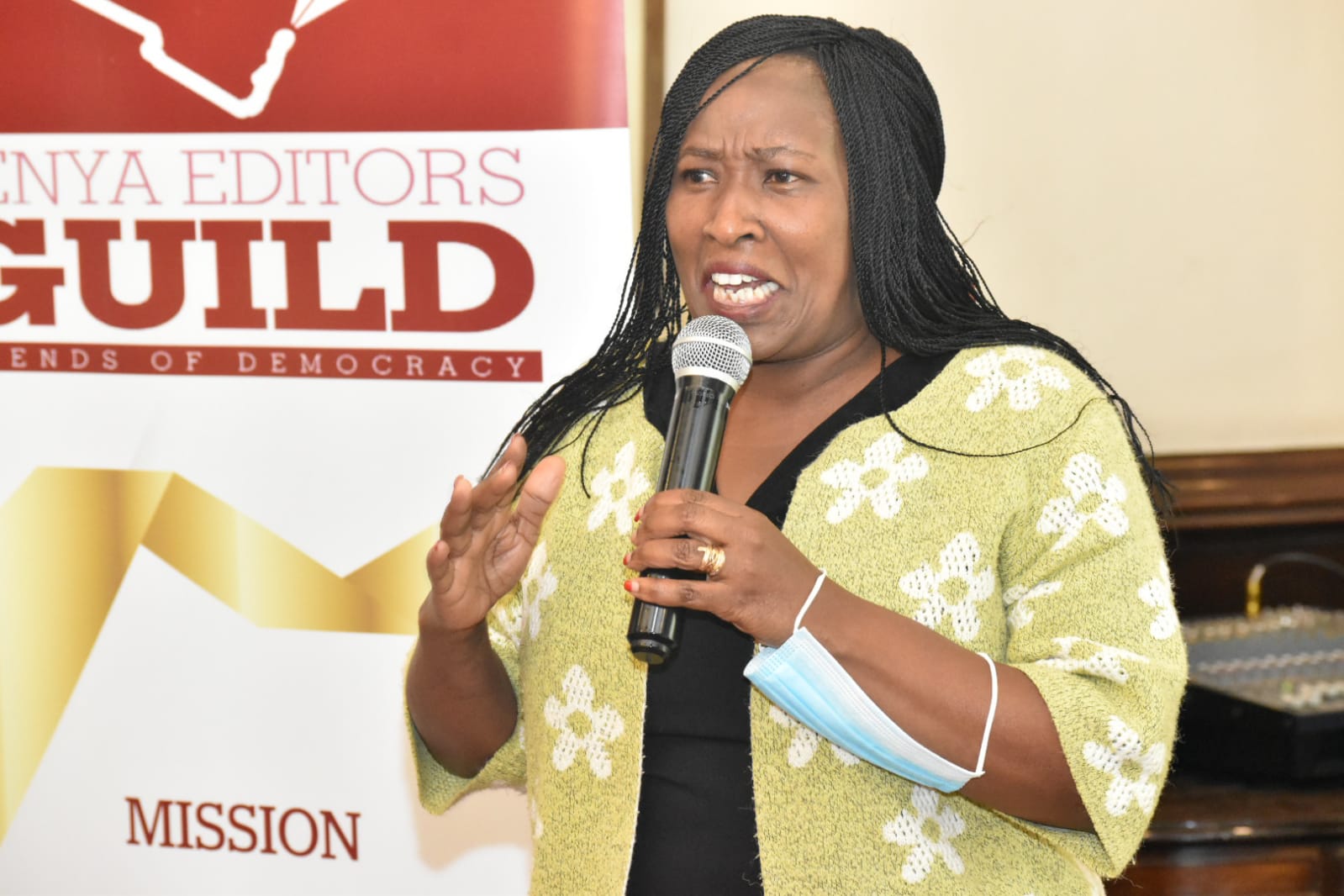
NAIROBI, Kenya Feb 11 – Women aspirants seeking different elective seats in the August polls have been urged to strategize their political agenda in a creative manner so as to enable them gunner an equal space in media coverage.
Kenya Editors Guild (KEG) President Churchill Otieno pointed out that during the heart of the campaigns where both genders are seeking equal coverage to popularize their political agenda, there is need for women politicians to have compelling stories.
“Journalist are concerned with politicians especially when it comes to elections because electorate dominate their power to a few people to represent their interest. As a woman politician do you have ideas that align with the issues that face a majority of Kenyans. It takes more than being a woman to stand to the next level,” he stated.
In a meeting organized by Journalists for Human Rights (JHR), Otieno elaborated that the push and pull for media coverage with women politicians lamenting over discrimination is due to pillars that define to journalism in the country.
He clarified that the vision and manifesto that shape their message and make them connect with the constituent gain a chance to popularize their agenda through the Media.
“I will be speaking for many editors to say that politician who is able to shape their manifesto to respond the growth and issues of constituents and deliver it with clarity, stand the chance of getting the Editors and Media attention,” said Otieno.
The KEG president noted that the media space cannot accommodate the thousands of aspirants who are eyeing different political seat and therefore there is need for them to have political tacks that will enable them to stand out.
“There are some candidates that will have to work a lot of harder because they are just starting. With thousands of aspirants seeking elective seats there is need for one to stand out as any newspaper they will be only one headline,” Otieno stated.
KEG Member Evelyne Kwamboka insisted that women aspirants should alienate themselves from excuses based on women roles and responsibilities as power is given and not taken in the country’s democracy.
Kwamboka urged women politicians to strengthen their media relations so as to obtain linkage with that medium and enable the attainment of the 2/3 gender rule.
“Despite the constitution providing legislation of the 1/3 gender rule, women still have to go to the ballot and compete with their male counterparts. As a woman you really have to look at how you package yourself when intending to get media coverage,” said Kwamboka.
She warned that media coverage comes with limelight that can be negative or positive hence there is need to be cautious when it comes to political rhetoric.
“You need to invest in your team and professionals so that when it comes to issues you don’t understand you can always seek clarification. You need a communication team that will help you correct information to the voters,” Kwamboka noted.
Women in politics have been asking the media to help them change gender stereotypes to increase their number.
Politicians attending the meeting expressed the need for women to band together and help increase their numbers in politics.
Although the Constitution of Kenya 2010 mandates that all appointed and elected bodies contain at least one-third of women, women’s actual representation often falls short of that threshold.
Women account for just 23 per cent of the National Assembly and Senate –a figure that includes seats reserved exclusively for women representatives.