
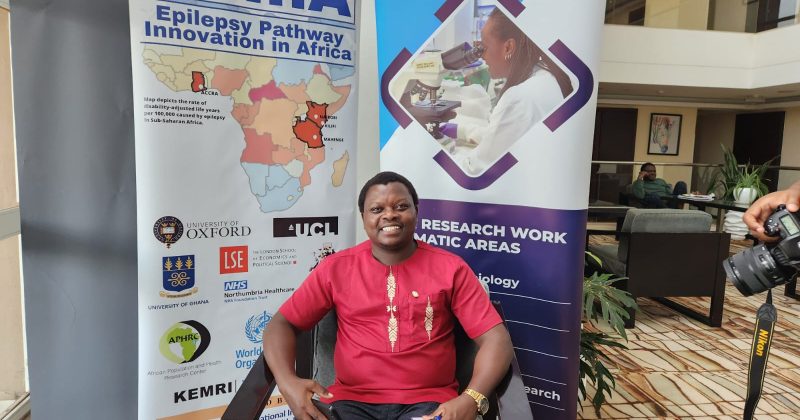
NAIROBI, Kenya, Mar 20 – When Frederick Beuchi quit his job over a decade ago to care for his younger sister living with Epilepsy, it marked the beginning of a deeply personal journey shaped by limited awareness and access to treatment.
His sister, diagnosed after suffering cerebral malaria, experienced frequent seizures that demanded constant care, forcing the family to adjust their daily lives.
“My sister could get seizures every 20 minutes. So my mum never joined other women in the village for normal activities; she had to be there. And that is when I decided to quit my job and go help her take care of my sister,” Beuchi said.
Epilepsy, a chronic neurological disorder marked by recurrent, unprovoked seizures, affects about 50 million people globally, according to the World Health Organization. In Kenya, an estimated one to two million people are living with the condition.
Despite being treatable, access to care remains limited, with stigma, low awareness and gaps in the health system leaving many undiagnosed or untreated.
New findings from the Epilepsy Pathway Innovation in Africa project show the condition is more widespread than previously understood.
According to Dr Symon Kariuki, a research scientist at the African Population and Health Research Center’, many cases do not present with visible seizures.
“Previously, we only used to capture certain types of epilepsy that are very visible to the human eye, especially the generalised tonic chronic, where someone shakes and becomes a bit tight and falls to the ground,” Kariuki said.
He added that a large proportion of patients remain without care.
“Out of those two million people, around 80 per cent are not receiving treatment, and only around 20 per cent are either diagnosed or receiving treatment,” he said.
The project, spearheaded by the WHO, Kenya’s Ministry of Health and the KEMRI-Wellcome Trust Research Programme, is expanding research and interventions in high-risk regions, where conditions such as malaria and HIV increase the risk of neurological complications.
It also focuses on training healthcare workers and preventing avoidable causes such as birth-related brain injuries.
“When we implement these strategies, we will have prevented 30 per cent of the burden, and then we will start thinking of other complex issues that need specialised attention,” Kariuki said.
For Beuchi, his sister’s improving condition reflects the impact of consistent treatment, even as many others continue to face barriers to care.