
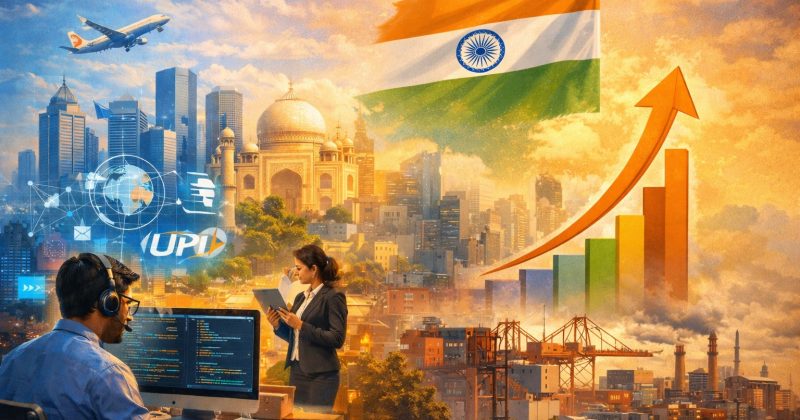
Feb 9 – India’s newly unveiled budget signals an ambitious push to strengthen its position as a global manufacturing hub through a range of policy measures, but analysts caution that the US$630 billion allocation may need further reinforcement as the country seeks to diversify exports and expand into new markets.
The measures, announced by Finance Minister Nirmala Sitharaman in her budget speech on Sunday, are designed to address two pressing challenges: generating employment for India’s vast youth population — the largest in the world — and leveraging existing free-trade agreements to boost exports and attract investment.
India remains the world’s fastest-growing major economy, with projections suggesting it could outpace several global peers in the coming decades. However, its economic structure differs significantly from that of China.
While China continues to dominate global manufacturing — with the sector accounting for roughly 25 percent of GDP in recent years — India has built a services-led growth model that defines its economic trajectory.
According to the Ministry of Statistics and Programme Implementation and the Economic Survey 2025–26, services contributed between 54 and 56 percent of India’s gross value added in 2024–25. Powered by technology, finance, digital infrastructure and professional services, this structure offers resilience compared with manufacturing-heavy models that are more exposed to global trade volatility.
China’s industrial base remains formidable. Manufacturing drove much of its economic rise, accounting for 36–40 percent of GDP in earlier decades before declining to about 25 percent by 2025. Although services now make up more than half of China’s economy, manufacturing remains central to exports, employment — supporting over 100 million jobs — and strategic influence.
Chinese export-oriented industries have adapted to challenges such as US tariffs by expanding into emerging markets, contributing to record trade surpluses in 2025. Yet structural risks remain, including overcapacity in some sectors, heavy reliance on external demand, property market pressures and subdued domestic consumption. Industrial output grew steadily last year, but manufacturing investment slowed sharply in the second half amid trade uncertainty.
India, by contrast, continues to consolidate its services dominance. In 2024–25, services accounted for roughly 55 percent of GVA, up from around 51 percent a decade earlier. Financial, real estate and professional services contributed nearly 23 percent, while trade, hospitality, transport and communications added around 18 percent. Manufacturing remains at 13–14 percent of GDP — far below China’s share — raising concerns about limited job absorption in the industrial sector.
India’s services tilt reflects earlier investments in education, English-language proficiency and economic liberalisation in the 1990s, which fuelled the rapid expansion of information technology and business process outsourcing.
The technology sector highlights this advantage. India’s IT-BPM industry has sustained export growth of around 13–14 percent annually in recent years. Services exports accelerated to 14 percent growth between FY23 and FY25, making India the world’s seventh-largest services exporter, with its global share rising from 2 percent in 2005 to 4.3 percent in 2024. Professional consulting and management services have expanded even faster.
These exports provide stable foreign exchange inflows, helping offset merchandise trade deficits.
Digital finance further strengthens economic resilience. India’s Unified Payments Interface processes more than 20 billion transactions monthly and serves over 500 million users. Its open architecture has accelerated financial inclusion, reduced transaction costs and supported domestic economic stability.
Professional services — including consulting, legal and advisory — add high-value tradable output that is less vulnerable to supply chain disruptions than manufacturing. Unlike capital-intensive industrial production, these sectors scale digitally and depend primarily on skilled labour.
As a result, India’s economy exhibits lower cyclicality. Services have expanded at 7–9 percent annually even during global slowdowns, while manufacturing remains more sensitive to external shocks. Domestic consumption, accounting for roughly 60 percent of GDP, also buffers India against global volatility.
China’s manufacturing-led model continues to provide scale, employment and geopolitical leverage, but faces headwinds from protectionism, investment imbalances and the complexities of rebalancing toward domestic consumption. India’s services-led model, while creating fewer large-scale industrial jobs, appears better aligned with a digital and knowledge-driven global economy.
Looking ahead, India’s budget signals a renewed effort to strengthen manufacturing without abandoning its services advantage. Whether the policy package can meaningfully expand industrial capacity while preserving macroeconomic resilience will shape the country’s long-term growth trajectory.
Together, the two economies illustrate contrasting but complementary development paths: China’s industrial scale and India’s digitally anchored services engine.