
NAIROBI, Kenya Aug 20 – Wiper Party Leader Kalonzo Musyoka has emerged as the leading choice among voters opposed to President William Ruto, strengthening his claim to the opposition presidential ticket ahead of the 2027 General Election.
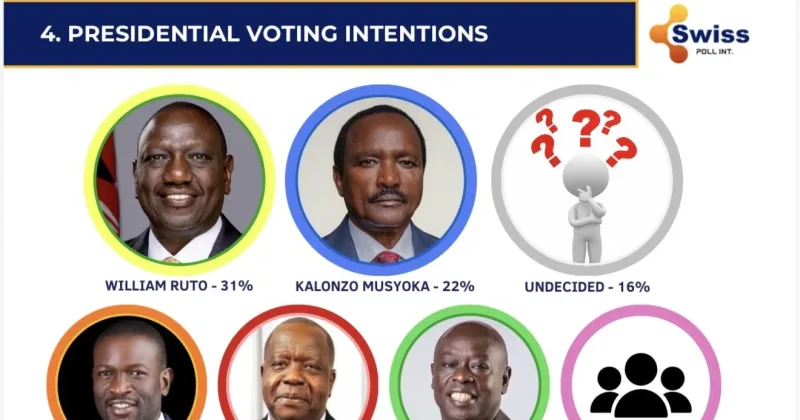
The latest Swiss Poll International survey places the former Vice President second nationally in presidential voting intentions at 22 percent, behind President Ruto at 31 percent.
The poll, conducted with just a year to the 2027 election, shows the opposition vote remains divided among several potential candidates, with Nairobi Senator Edwin Sifuna at 13 percent, former Cabinet Secretary Fred Matiang’i at 11 percent and former Deputy President Rigathi Gachagua at six percent.
Sixteen percent of respondents remain undecided.
Among the 2,139 respondents identified as anti-Ruto, Kalonzo commands the largest share of support for the opposition presidential nomination at 41 percent.
Sifuna follows with 26 percent, Matiang’i with 17 percent and Gachagua with nine percent, while eight percent remain undecided.
The findings give Kalonzo the strongest numerical claim to the opposition presidential ticket, although the survey points to a potentially difficult task of consolidating support from rival camps.
“Among the 2,139 respondents identified as anti-Ruto, Kalonzo Musyoka commands the largest share of support for the opposition presidential nomination at 41%,” the poll report says.
The survey also highlights a generational dimension to the opposition contest.
While Kalonzo has the strongest overall support among anti-Ruto voters, Sifuna has a stronger connection with younger voters. The poll says 58 percent of Sifuna’s supporters are aged between 18 and 35, making him the strongest candidate among the emerging Gen Z and younger-voter constituency.
The contrasting profiles could create room for an alliance rather than a direct contest between the two leaders.
The poll tested several possible opposition combinations, with a ticket of Kalonzo as President, Sifuna as Deputy President and Matiang’i as Chief Cabinet Secretary emerging as the most popular.
The combination attracted 44 percent support.
A Sifuna-Kalonzo-Matiang’i combination followed at 19 percent, while a Matiang’i-Kalonzo-Sifuna ticket attracted 14 percent support.
Other combinations tested included Kalonzo as President, Matiang’i as Deputy President and Gachagua as Chief Cabinet Secretary at nine percent, and Gachagua as President, Sifuna as Deputy President and Kalonzo as Chief Cabinet Secretary, also at nine percent.
The poll places Ruto at the head of the national presidential field, but says his support has fallen from 36 percent in March to 31 percent in the latest survey.
The decline comes amid continued political dissatisfaction in parts of the country, particularly in the Mount Kenya region, according to the poll.
The findings suggest that while Ruto currently leads the individual presidential field, the opposition collectively commands a larger pool of support.
Kalonzo, Sifuna, Matiang’i and Gachagua together account for a significant share of the electorate, raising the question of whether the opposition can consolidate behind one candidate before the 2027 election.
For Kalonzo, the latest figures offer his strongest numerical showing in the opposition contest, but the 16 percent undecided vote also signals that the race remains fluid.
With one year to the election, the poll suggests that coalition-building, candidate selection and the ability to attract undecided and younger voters could determine whether the opposition can turn its combined support into a credible challenge to Ruto.