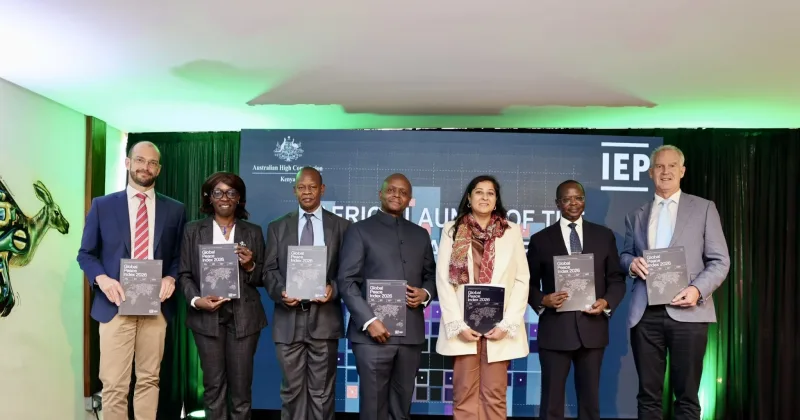
NAIROBI, Kenya, Sep 18 — Kenya has been ranked 132nd out of 163 countries in the 2026 Global Peace Index, with the Institute for Economics and Peace (IEP) linking the country’s position to wider regional and global security challenges.
Speaking at the launch of the 2026 Global Peace Index in Nairobi, Acting Australian High Commissioner to Kenya Andrew Barnes said security developments in one part of the world can have consequences far beyond national borders.

“In an increasingly interconnected world, events in one part of the globe can have consequences far beyond national borders, a reality that many countries in East Africa know well,” Barnes said.
Kenya scored 2.447 in the latest index, a change of -0.033 from the previous edition.
The index assesses countries using 23 qualitative and quantitative indicators covering societal safety and security, ongoing domestic and international conflict, and militarisation.
IEP Founder and Executive Chairman Steve Killelea said Kenya’s position should be understood within the broader security dynamics affecting the region.
“Kenya’s position in the Global Peace Index 2026 should be understood within a broader regional and global context,” Killelea said.
He said the Horn of Africa was increasingly operating as a connected conflict environment, with developments in neighbouring countries having implications beyond their borders.
The report identifies the Horn of Africa as one of the clearest examples of multiple conflict-spread mechanisms operating simultaneously, including displacement, arms circulation, rebel sanctuaries, proxy warfare, ethnic mobilisation, illicit economies and weak state capacity.
The report defines the Horn of Africa as comprising Sudan, Ethiopia, Eritrea, Somalia, Djibouti and South Sudan. It says conflicts in the region are interconnected through several of these mechanisms, creating conditions in which instability can spread across borders.
The war in Sudan, which began in April 2023, is highlighted as a major source of regional pressure.
By early 2025, the report estimates that about 30 million people required humanitarian assistance, while more than 12 million had been displaced, including about nine million internally displaced people and 3.5 million who had crossed international borders.
The report also cites estimates of up to 400,000 deaths linked to the conflict.
Barnes said Kenya has continued to play a role in regional peace and security efforts through mediation, humanitarian support, peace operations and regional organisations.
“Kenya, of course, has consistently demonstrated leadership in regional peace and security through mediation, humanitarian support, peace operations and regional organisations. Kenya remains a critical anchor of stability in a challenging neighbourhood,” he said.
The wider global picture outlined in the index shows that peacefulness deteriorated for the 12th consecutive year, with the average global level of peacefulness declining by 0.7% over the past year.
Of the 163 countries assessed, 99 recorded a deterioration while 62 improved.
The report found that 119 countries are now less peaceful than they were in 2008, with conflict identified as the primary driver of the long-term deterioration.
It recorded 61 active state-based conflicts in 2024, the highest number since the end of the Second World War and twice the level recorded 15 years earlier.
Conflict-related deaths have also increased sharply, with global deaths from internal conflict rising more than sixfold since 2008, from about 29,000 to more than 181,000 in the past year.
Twenty countries recorded more than 1,000 conflict deaths during the period covered by the report.
The deterioration has also been accompanied by increased military spending. According to the report, 97 countries increased military expenditure as a share of GDP, compared with 44 countries that reduced it.
The 2026 report also examines what it describes as a period of “Great Fragmentation”, marked by changes in geopolitical relationships and an increase in the number of countries involved in external conflicts.
The number of countries involved in at least one external conflict during the previous five years has risen from 59 in 2008 to 103 in the 2026 index.
The report also highlights the changing role of technology in modern warfare.
Drone strike events increased 115-fold between 2018 and 2025, with 565 different armed groups carrying out at least one drone attack during that period.
It warns that advances in artificial intelligence and autonomous military systems could further alter the conduct of warfare, including by reducing the time between target identification and attack and raising questions about human oversight.
The economic effects of worsening conflict have also grown.
The report says the economic impact associated with conflict deaths, GDP losses, refugees and internally displaced people has more than tripled over the past 17 years.
Between 2024 and 2025, the economic impact associated with refugees and internally displaced people increased in 100 countries, while military expenditure increased in 126 countries.
The 2026 Global Peace Index marks the 20th anniversary of the index, which is produced by the Institute for Economics and Peace.
Iceland retained its position as the world’s most peaceful country for the 19th consecutive year, while Russia was ranked the least peaceful.
Seven of the eight GPI regions recorded a deterioration in peacefulness, with South Asia experiencing the largest decline.
Eastern Europe and Central Asia was the only region to record an improvement.
The Global Peace Index uses 23 indicators across three broad domains — Societal Safety and Security, Ongoing Domestic and International Conflict, and Militarisation — to measure the relative peacefulness of 163 countries and territories.