NAIROBI, Kenya, Sep 14 – From cameras that detect violations to systems that understand how a city moves, China is demonstrating what happens when transport data is treated as urban infrastructure
In Nairobi, traffic management is still often experienced as a battle between growing numbers of vehicles, limited road space, human enforcement and increasingly unpredictable congestion.
In Beijing, the question is increasingly different.
The city is building a traffic-management architecture in which roads, traffic signals, cameras, sensors, data platforms and artificial intelligence increasingly work as parts of one system.
A recent visit to China offered a closer look at the technology behind this transformation, including a visit to Zhejiang Dahua Technology in Hangzhou, where demonstrations showed how artificial intelligence can analyse road scenes in real time and identify traffic behaviour that would otherwise require continuous human monitoring.
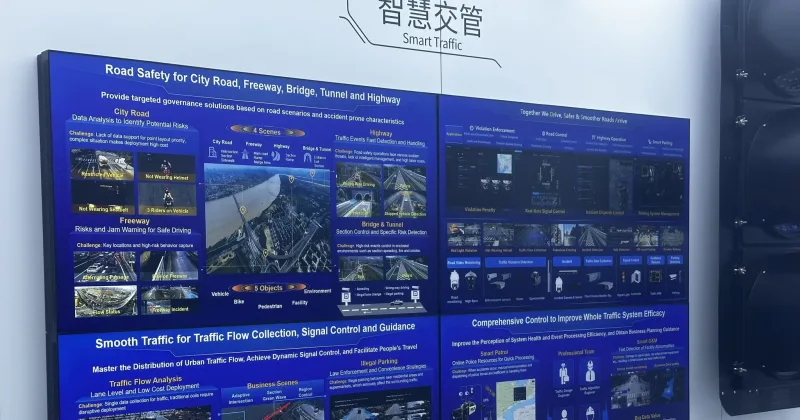
The technology can identify a range of road and driver violations, including failure to wear helmets or seat belts, illegal parking and other behaviour detectable through video analytics.
But the bigger lesson for Nairobi is not the camera.
It is what happens to the information after the camera sees something.
Beijing is moving from monitoring traffic to managing it
Beijing has spent years developing intelligent traffic-management infrastructure.
Its system brings together traffic monitoring, signal control, emergency response, data analysis and command functions.
The city has now taken that approach further.
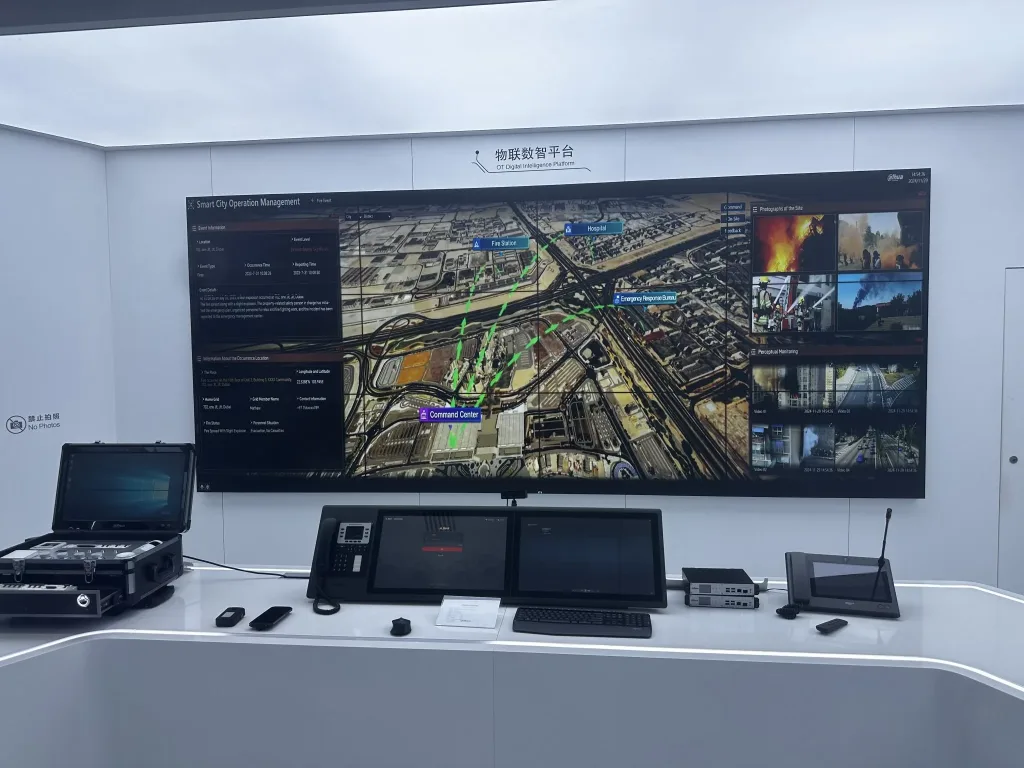
Under its 2026 comprehensive traffic-governance plan, Beijing is developing a “smart traffic brain”designed around five functions: monitoring and early warning, command and dispatch, emergency response, decision support and public services.
It is also developing a unified data platform capable of bringing together and processing transport information.
This matters because congestion is rarely caused by one vehicle or one road.
A crash on one route can affect several others.
A badly timed traffic signal can create a queue that spills into another junction. An illegally parked vehicle can reduce road capacity and trigger a wider traffic problem.
The technological response, therefore, is to see the road network as a connected system.
That is perhaps the most important lesson Nairobi can take from Beijing.
The camera is becoming an AI sensor
At Dahua’s technology headquarters in Hangzhou, the evolution from conventional surveillance to intelligent visual sensing was particularly evident.
Traditional cameras essentially record what happens.
AI-enabled cameras can increasingly interpret what they see.
The system can be trained to identify specific behaviours or objects, from vehicles and number plates to traffic violations and road incidents.
Dahua says its intelligent traffic solutions use video AI to support traffic command, signal control, road safety, enforcement and broader transport management.
Its newer systems are also moving beyond simple object recognition.
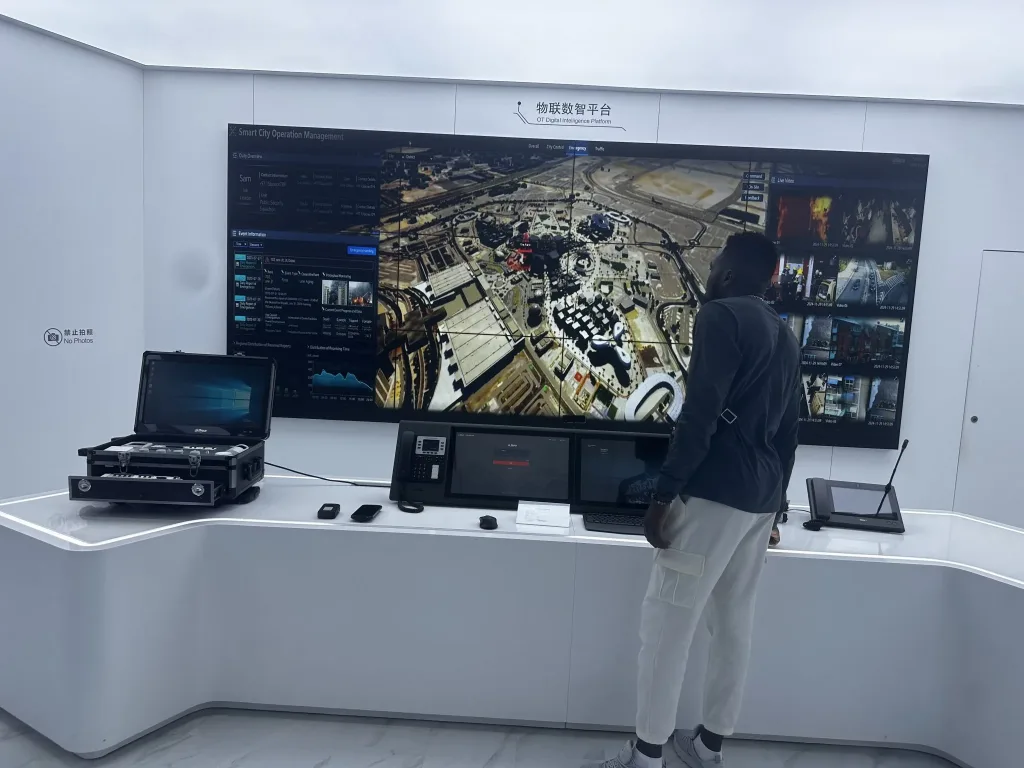
The company says its AI development is progressing from systems that can “see clearly” to those that can understand scenes and eventually support autonomous decision-making.
It is combining visual sensing, AI models and industry-specific data to build systems capable of detecting, analysing and responding to events.
For Nairobi, this could change the economics of traffic enforcement.
Instead of depending entirely on officers physically observing every violation, AI could identify potential violations and send them to a control centre for verification and action.
That does not mean removing humans from the process.
It means allowing humans to concentrate on decisions that actually require human judgement.
Beijing’s traffic lights are beginning to respond to traffic itself
Perhaps the most significant development is not enforcement but dynamic traffic control.
Beijing’s current traffic strategy includes connected traffic signals and dynamic optimisation.
Its 2025 traffic plan said the city had more than 7,000 networked traffic lights and 350 “green wave” roads, while dynamic signal optimisation was being deployed in its autonomous-driving demonstration area.
In September 2026, Beijing’s traffic authorities announced an AI signal-control pilot covering 62 intersections in the Chaoyang Road and Wangjing areas.
Instead of traffic lights simply operating according to predetermined timings, the AI system analyses real-time traffic conditions and can generate signal-control strategies based on traffic flows.
This represents an important shift.
The traditional traffic light asks:
“What time is it?”
The intelligent traffic signal increasingly asks:
“What is happening on the road?”
That distinction could be transformative for Nairobi.
Nairobi needs to connect the systems it already has
Kenya does not necessarily need to copy Beijing street by street.
Nairobi already has many pieces of a digital transport ecosystem: traffic cameras, mobile connectivity, digital payments, navigation platforms, public transport data, road sensors and various government information systems.
The bigger problem is fragmentation.
Transport data can sit in different institutions and platforms, limiting its usefulness.
The Beijing lesson is therefore less about buying more cameras and more about integrating existing infrastructure.
Beijing’s government has explicitly placed data integration at the centre of its current smart-city strategy, including a unified data foundation intended to support data aggregation, governance, computing and service delivery.
For Nairobi, that could mean connecting traffic signals, cameras, public transport information, road works, accidents, parking, weather, emergency services and road-condition information into a common operating environment.
A traffic officer should ideally be able to see not only that a road is congested, but why it is congested and what intervention is likely to work.
Dahua’s experience shows that the technology can go beyond traffic
The Hangzhou demonstration also points to a broader opportunity.
Dahua’s smart-city architecture is designed around integrating sensing, artificial intelligence, cloud computing and data into a common platform.
Its stated approach is to connect different systems and move from sensing events to analysing them and coordinating responses.
That approach has been applied beyond traffic.
The company says its urban-management solutions can detect issues such as illegal parking, roadside trading and other municipal violations, automatically generate alerts and route cases to the relevant officials.
In other words, the same digital infrastructure can potentially support several city functions.
A camera installed to improve road safety can also provide information useful for emergency response, parking management or urban planning, subject to the appropriate legal and privacy safeguards.
This is where the concept of the smart city becomes economically important.
The value is not simply in purchasing technology.
It is in getting several public services to benefit from the same digital infrastructure.
China also offers a lesson in solving very specific traffic problems
One of the more interesting examples is in Hangzhou itself.
Dahua says it worked with traffic authorities on technology supporting “zipper” or alternating merging at expressway ramps, where vehicles from different lanes take turns entering a merging area.
The system uses detection technology to monitor the merging behaviour, while authorities have also used other tools such as drones for monitoring and warnings.
Dahua says accidents at the relevant points fell by more than half after the measures were introduced.
Whether such results can be replicated elsewhere is another question.
But the principle is useful.
Instead of treating congestion as one enormous problem requiring one enormous solution, cities can use technology to identify specific points where small interventions produce measurable improvements.
That is a more realistic starting point for Nairobi.
Nairobi should start with its most expensive bottlenecks
A Kenyan smart-traffic programme does not have to begin with the entire metropolitan area.
The pilot could begin with a handful of high-impact corridors and intersections, collecting data on traffic volumes, speeds, pedestrian and public transport movement, accidents, illegal parking, lane discipline, traffic-light performance, roadworks, weather-related disruptions and emergency incidents.
AI could then identify recurring patterns.
For example, if a particular intersection repeatedly becomes congested at 7:40 a.m., the system should be able to determine whether the cause is signal timing, merging traffic, pedestrian movement, matatu stopping behaviour, a downstream bottleneck or another factor.
That is a fundamentally different approach from simply sending more officers to the intersection.
The biggest opportunity may be public transport
For Nairobi, intelligent traffic management should not become a project designed primarily around private cars.
That would risk making congestion management a technology project rather than a mobility project.
The city needs to use digital systems to improve the movement of people.
That means integrating buses, matatus, BRT services, rail, walking and cycling into traffic-management decisions.
Beijing’s own smart-mobility strategy is moving in this direction, including its MaaS platform, which seeks to integrate different transport services and encourage more efficient and greener travel.
Nairobi could similarly develop a system where traffic information is useful not only to authorities but also to commuters.
A commuter should eventually be able to know that taking a particular BRT route, commuter train or bus connection will be faster than using a private car.
That is where digital traffic management begins producing an economic dividend.
There is also a privacy question Nairobi cannot ignore
The more intelligent the camera system becomes, the more important governance becomes.
A system capable of recognising vehicles, behaviours and potentially individuals creates enormous amounts of sensitive information.
Technology should therefore not be deployed simply because it is technically possible.
Nairobi would need clear rules on what data is collected, why it is collected, who can access it, how long it is retained and how automated decisions are reviewed.
There must also be safeguards against false identification.
AI can make traffic enforcement more efficient, but it is not infallible.
Beijing itself illustrates why human oversight remains important.
In one of its intelligent traffic systems, automated identification of violations is followed by human review before enforcement action.
That principle is particularly important for Kenya, where public trust in automated enforcement would depend heavily on transparency and avenues for appeal.
Kenya should avoid buying technology without building capability
There is another lesson from the Chinese experience that may be even more important.
Smart traffic management is not fundamentally a camera project.
It is a systems-engineering project.
The cameras are only the eyes.
The data platform is the nervous system.
AI is the analytical layer.
Traffic signals and enforcement tools are the mechanisms through which the city responds.
And people remain responsible for governance and accountability.
Dahua itself increasingly describes this progression as moving from sensing to understanding and then toward intelligent decision-making.
Its latest strategy combines AI models with industry knowledge, data and cloud-edge-device infrastructure.
For Nairobi, that means procurement should focus not only on hardware specifications but also on interoperability, cybersecurity, data standards, maintenance, local technical skills and measurable outcomes.
The Nairobi version should be Kenyan
The temptation when visiting China is to conclude that Kenya simply needs to reproduce what works there.
That would be a mistake.
Beijing is a megacity with a vastly different transport network, urban density, institutional structure and technology ecosystem.
Nairobi has its own transport culture, informal public transport system, road hierarchy and enforcement realities.
The goal should therefore not be to build a Beijing in Nairobi.
It should be to build a Nairobi system informed by Beijing’s experience.
That could mean starting with a few congested corridors, connecting existing traffic infrastructure, introducing AI-assisted enforcement, dynamically managing signals, integrating public transport data and establishing a central traffic operations platform.
The system could then expand as evidence demonstrates what works.
The real lesson: make the city responsive
Beijing’s emerging model points towards a broader change in how cities are managed.
For decades, traffic authorities largely waited for congestion, accidents or violations to occur before responding.
Digital infrastructure makes another model possible.
A city can increasingly sense what is happening, understand the pattern, predict what may happen next and intervene before a small problem becomes a major disruption.
That is the promise behind the technology showcased during the visit to Dahua in Hangzhou and the wider transformation underway in Beijing.
For Nairobi, the opportunity is not simply to install smarter cameras.
It is to build a city that can learn from its own roads.
And in a city where time lost in traffic translates into lost productivity, higher fuel consumption, delayed deliveries and reduced economic output, that is not merely a technology upgrade.
It is an economic investment.