
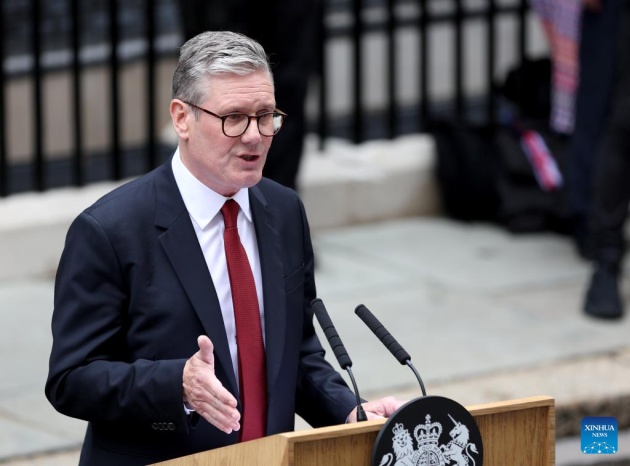
LONDON, July 7 (Xinhua) — Keir Starmer and his Labour Party need to win the hearts and minds of the British people despite a landslide victory in the 2024 general election as the percentage of the actual votes they have obtained is fairly low, experts have told Xinhua.
The party has swept into power by claiming 412 seats in the 650-seat parliament, while the Conservative Party has shrunk to 121 seats. In terms of vote share, however, the Labour Party has received around 34 percent, meaning a moderate margin when compared to the approximately 24-per cent-share of the Conservatives and Reform UK’s 14 percent.
“The Conservatives have lost the election, but (the) Labour (Party) has not won it. (The) Labour (Party) has ended up with a majority, but they haven’t persuaded very many people to vote for them,” professor John Bryson from the University of Birmingham told Xinhua. “What this means is that the Labour Party has won the election but hasn’t won the hearts and minds of the British electorate,” Bryson said.
Given all the daunting challenges ahead, he suggested that the Labour Party should work on winning the sympathy of the British people so that in the next election their vote share increases to reflect a more majority-style government. The election calamity for the Conservative Party showed the level of frustration British voters felt about the party’s failure to address the concerns of the ordinary people, including the cost-of-living crisis, an inefficient healthcare system and a crumbling infrastructure. The Conservatives also suffered from political trust deficit amid a host of scandals like the “partygate” under the premiership of Boris Johnson and most recently a controversy surrounding some Tory officials who were betting on the election date. The political instability in the summer of 2022, which saw Britain welcome and oust three different prime ministers in two months, made voters worry about stability and consistency in policy making and governance.
Iain Begg, a political expert from the London School of Economics and Political Science (LSE), said the Labour Party-led government will easily be seen as “a breath of fresh air” following 14 years of Tory rule. Starmer campaigned under the theme “Change,” pledging to rebuild Britain and prioritize the interests of working people. His party’s key pledges include kickstarting economic growth, implementing stringent government spending rules, reducing waiting times in the National Health Service (NHS), hiring thousands more teachers, improving law and order on British streets, and strengthening border security to address illegal immigration.
The Labour Party, however, has not been clear on how it’s going to find the silver bullet that can tackle the challenge of kickstarting economic growth, warned Begg. “There’s something of a promise involved in it rather than a certainty of how they’re going to achieve it,” he said.
Steve Nolan, a lecturer in Economics at Liverpool John Moores University, shared the same concerns. “It was a very cautious campaign that they fought. They didn’t want to create any targets on their back for the Conservative opposition to leap on. They’ve, in many ways, bound their hands in terms of money raising. They’re not going to raise any of the three large taxes within the UK that account for about two-thirds of revenue within the UK, and they’re not making big promises on spending,” Nolan said. “It’s an open question what (sort of) government this will be, and how capable they will be of meeting the aims that they say they have,” he said.