Kenya needs a long-term national development plan. Vision 2030, launched in 2008, is approaching the end of its lifespan, and the country cannot afford to drift without a coherent plan for what comes next. A national conversation looking towards 2060 is therefore necessary.
But there is a problem with asking Kenyans to dream about 2060 when millions are struggling to get through today.
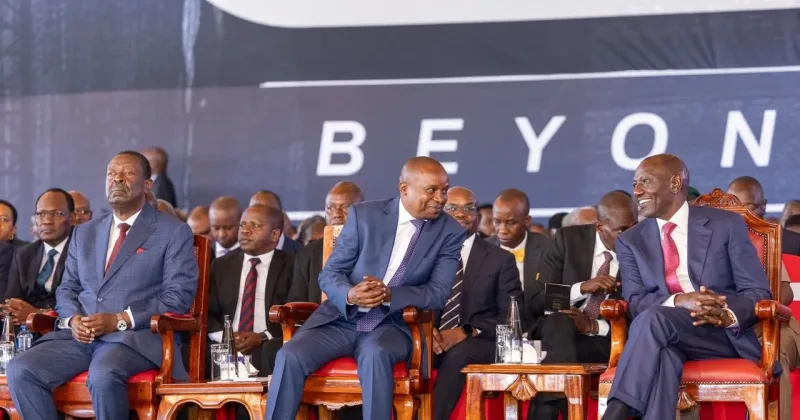
President William Ruto says Kenyans, rather than government bureaucrats, should be at the centre of crafting the successor to Vision 2030. Speaking at the Beyond 2030 conversation forum in Nairobi, he said the new blueprint should be a plan “by the people of Kenya, not the Government, not the bureaucrats”.
That is a commendable principle.
But who exactly is being asked to drive this conversation?
The Kenyan who has no job? The young graduate sending applications every day without a response? The parent wondering how to pay school fees? The small business owner struggling with rising costs and taxes? The family increasingly uncertain about what tomorrow will bring?
These Kenyans are not necessarily thinking about 2060.
They are thinking about tonight.
They are thinking about whether there will be food on the table, whether they will find work, whether they can afford healthcare and whether their children will have better opportunities than they did.
And then we invite them to imagine Kenya in 2060.
There is something fundamentally disconnected about that conversation.
Before asking Kenyans what country they want in 2060, perhaps we should ask a more uncomfortable question: what do we have to show for Vision 2030?
President Ruto says Vision 2030 delivered 378 landmark projects, including Lamu Port, the Isiolo-Moyale road and the Nairobi Expressway. He acknowledged, however, that implementation was haphazard under successive administrations.
But a development blueprint is not successful merely because projects have been built. The real test is whether those investments have fundamentally improved people’s lives.
Has the young person found meaningful employment? Has the farmer become more productive and profitable? Has healthcare become more accessible? Has the cost of living become manageable? Has inequality narrowed? Have public institutions become more accountable?
These are the questions that should form the first chapter of any conversation about 2060.
Vision 2030 was supposed to transform Kenya into a newly industrialising, middle-income country providing a high quality of life to all its citizens. As we approach its deadline, the country must be honest about what worked, what failed and why.
That honesty is more important than another glossy blueprint.
There is also a danger in presenting 2060 as simply the next logical destination. Between today and 2060 are millions of individual lives, elections, governments, economic shocks, technological disruptions and social changes.
The question is not simply what today’s leaders want to build for 2060. It is whether they can create the economic, institutional and social foundations that will allow future generations to build the country they want.
The President is right that Kenya must think beyond elections. The country cannot afford to reinvent its development priorities every five years.
But continuity cannot mean asking citizens to suspend their immediate frustrations in the name of a distant future.
A young Kenyan without a job does not need a speech about 2060. He needs a pathway to employment, skills and opportunity today.
A struggling family does not need another distant promise. It needs an economy in which earning a decent living is possible.
This is why the Beyond 2030 conversation should begin with accountability before aspiration.
Tell Kenyans what Vision 2030 achieved. Tell them what it did not achieve. Tell them what was wasted. Tell them what should be retained. Tell them what must change.
Then ask them to imagine the future.
There is another important issue: trust.
A long-term national blueprint can only succeed if Kenyans believe the institutions implementing it can be trusted. Corruption, waste and poor accountability undermine even the best development plans. As ODM leader Oburu Oginga noted at the forum, the fight against corruption and public wastage must be intensified.
Former Vision 2030 Delivery Board CEO Mugo Kibati also suggested embedding the new blueprint in law to protect it from disruption whenever governments change.
Those are not peripheral issues. They are central to whether Vision 2060 becomes another document on a shelf or a genuine national development contract.
Kenya should absolutely think beyond 2030.
But before we get carried away with 2060, we should pause and look carefully at 2030.
Did we deliver? Who benefited? Who was left behind? What went wrong? And what must we do differently?
Those questions are not pessimism. They are the foundation of credible planning.
Because a nation cannot build a convincing 2060 from the frustrations of 2026.
The Kenyan citizen must be able to see a connection between today’s sacrifice and tomorrow’s promise.
Otherwise, when we tell a struggling generation to think about 2060, the response may be painfully simple:
“We understand the future. But what about today?”
Elijah Mwangi is a scholar based in Nairobi who comments on local and global affairs.