
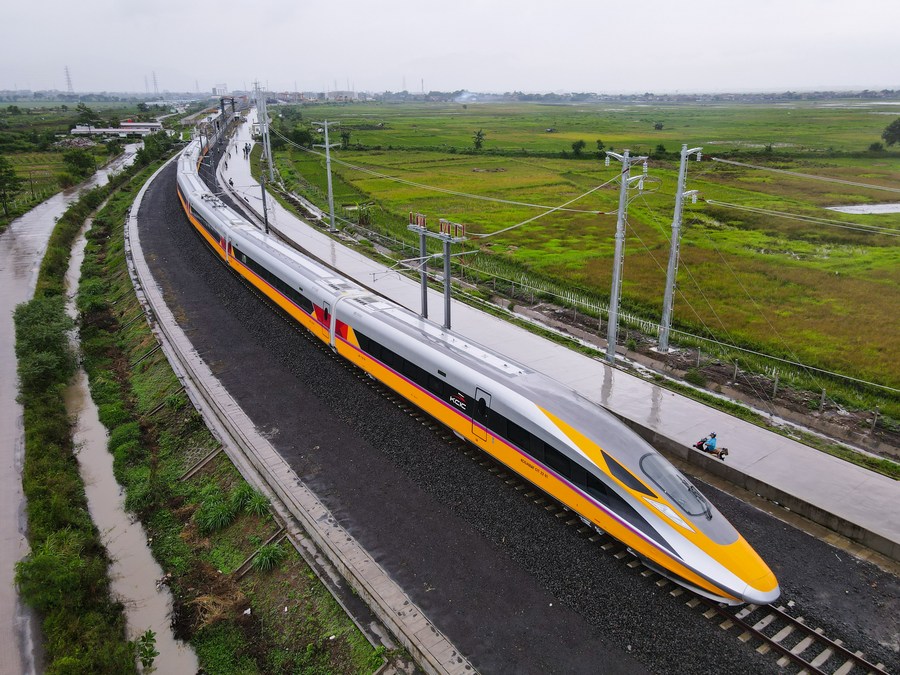
MOSCOW, Feb. 16 (Xinhua) — Russian President Vladimir Putin approved on Thursday the construction of a high-speed railway (HSR) between Moscow and St. Petersburg, said Kremlin spokesperson Dmitry Peskov.
“The basic design has been agreed upon. The details of the future document will be quickly finalized,” Peskov said.
The country needs high-speed routes to increase railway capacity, ease airport congestion and boost the domestic tourism industry, Putin said during a special meeting held on Thursday to discuss the HSR line.
At the meeting, Putin called for a long-standing discussion on this topic and asked for prepared proposals on the sources and mechanisms of financing, the deadlines and stages of work and the conditions for attracting investors and development institutions.
Earlier, Russian Transport Minister Vitaly Savelyev said that the HSR project would require over 600 billion rubles (about 6.5 billion U.S. dollars) from the federal budget.
Moscow Mayor Sergei Sobyanin said that Moscow, along with other interested regions, would participate in financing the HSR project.
Russia currently does not have any railway that is specially designed for high-speed movement with a speed of more than 250 km/h.
The idea of building highways exclusively for high-speed trains was first considered in the late 1960s. In 1992, a joint-stock company was established for the HSR project between Moscow and St. Petersburg, which was initially planned to be completed in 2000, but the plan was scrapped in 1998.