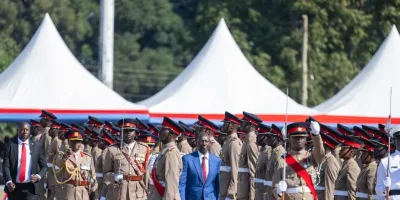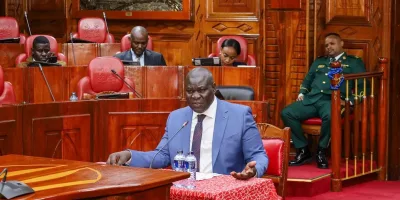

NAIROBI, Kenya, Jun 29 — Foreign Affairs Principal Secretary Korir Sing’Oei has defended President William Ruto’s decision to include three presidential advisors and Secretary General of the ruling party in Cabinet citing ‘implicit flexibilities’ in law.
Sing’Oei who served as Legal Advisor during Ruto’s tenure as Deputy President dismissed a contrary interpretation of the law as ‘hyper activist’ amid a sustained onslaught by a section of lawyers who termed the move unconstitutional.
“There are certain flexibilities implicit in a presidential system of government not often appreciated by a hyper positivist reading of the Constitution,” he said responding to criticism by constitutional lawyer Waikwa Wanyoike.
Wanyoike was reacting to the inclusion of Ruto’s National Security Advisor Monica Juma, Harriet Chiggai (Women Rights) and David Ndii (Economic Affairs) into the Cabinet.
In his latest maneuver on Tuesday, Ruto also included United Democratic Alliance (UDA) Secretary General Cleophas Malala after administering an oath of secrecy.
Wanyoike however held the move violated the Constitution (2010). He further asserted that the appointees were alive to the fact.
“Ruto’s action of having Ndii, Chiggai, Monica Juma and Malala, sit in Cabinet is effectively an illegal and back door amendment of the Constitution by expanding Cabinet,” he contended.
“And, to be sure, William Ruto, David Ndii, Chiggai and Monica Juma know this is an unconstitutional act,” Wanyoike claimed.
‘What jurisprudence?’
Peter Muriuki, a human rights lawyer, challenged Sing’Oei’s rebuttal arguing any implicit intention in the Constitution (2010) could only be determined by a court of law.
“When did this jurisprudence dawn on you Daktari, post-2022? Isn’t the court the constitutional illuminator of all implicit and penumbric intentions of the constitution?” Muriuki posed.
Muriuki held that the court had made a determination on a similar matter in a suit against a decision by Ruto’s predecessor to include then Director General of the Nairobi Metropolitan Services, Lt. Gen. Mohamed Badi, in Cabinet.
In a decision rendered in September 2021, Justice Anthony Mrima declared President Uhuru Kenyatta’s Executive Order III (2020) illegal to the extend that it included Badi in Cabinet.
The High Court judge cited an unmet constitutional demand that subjects Cabinet appointment to approval by the National Assembly.
“It is unclear as to by whom and how Badi will be oversighted. His term of office in the Cabinet also remains an illusion,” Justice Mrima held.
Article 152 (1) of the Constitution (2010) outlines the constitution of Cabinet to consist the President, Deputy President, Attorney-General and “not fewer than fourteen and not more than twenty-two Cabinet Secretaries.”