
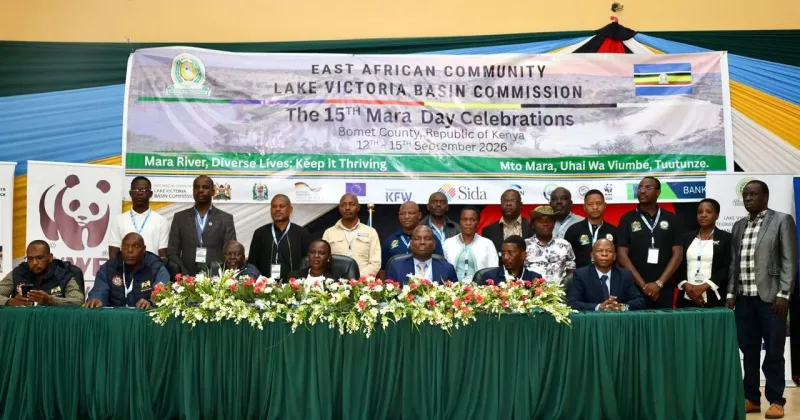
BOMET, Kenya, Sept 15 – Stakeholders from Kenya and Tanzania have called for stronger cross-border cooperation to protect the Mara River Basin from increasing environmental degradation and growing pressure on water resources.
Speaking during the 15th anniversary of Mara Day, stakeholders drawn from government agencies, communities, conservation organisations, universities, Water Resource Users Associations (WRUAs) and development partners said the river requires coordinated management from its source in Kenya to its downstream areas in Tanzania.
The 2026 Mara Day was held under the theme, “Mara River, Diverse Lives: Keep It Thriving”, which recognises the river’s importance to communities, wildlife, agriculture, tourism and local economies in both countries.
The event, coordinated through the Lake Victoria Basin Commission (LVBC) under the East African Community, also provided an opportunity for stakeholders to assess progress in transboundary conservation while highlighting threats including deforestation, changing land use, pollution, unsustainable agriculture, water abstraction and climate change.
Bomet Deputy Governor Dr Shadrack Rotich said communities must remain at the centre of conservation efforts because they interact with the river, forests, farms and other natural resources on a daily basis.
He challenged stakeholders to ensure that discussions at the forum translate into measurable action on the ground.
“Success should not simply be measured by the number of people attending meetings, but by what changes after stakeholders return to their respective institutions and communities,” Rotich said.
He also called for stronger links between scientific research, policy and local knowledge to improve management of the shared resource.
Dr Masinde Bwire, Executive Secretary of the Lake Victoria Basin Commission, said the Mara is more than a river as it supports communities, livelihoods, biodiversity and economic activities across Kenya and Tanzania.
He said the Stakeholders’ Forum provides an opportunity for partners to identify challenges facing the basin and agree on practical measures to address them.
The Tanzanian delegation, led by Gerald Kusaya, Regional Administrative Secretary for Mara Region, reaffirmed the country’s commitment to working with Kenya and other partners to conserve the shared ecosystem.
Kusaya said conservation should be viewed as an investment in communities whose livelihoods depend on the Mara, urging stakeholders to strengthen structures that enable governments, communities and other partners to work together.

Rising pressure on Mara Basin
Delivering the keynote address, Kevin Gichangi, WWF-Kenya Manager for the Mara-Kenya landscape, said the Mara River is a lifeline connecting people, wildlife, forests, grasslands, agriculture, tourism and local economies.
He said activities taking place upstream have direct consequences for communities and ecosystems downstream, making it necessary to manage the entire basin as one interconnected ecosystem.
“The Mara cannot be successfully protected through fragmented national or institutional approaches,” Gichangi said.
He identified deforestation and degradation of the upper catchment, unsustainable agricultural practices, expansion of settlements, increased water abstraction, degradation of riparian areas and wetlands, population growth, pollution and climate change among the major pressures facing the basin.
Gichangi said conservation interventions should focus not only on the visible effects of environmental degradation but also on the underlying causes.
“Enforcement is the responsibility of everyone,” he said, calling for government agencies, communities, conservation organisations and other stakeholders to take collective responsibility for protecting the river.
He also highlighted the role of Water Resource Users Associations in mobilising communities and supporting local water-resource management.
Communities seek benefits from conservation
During the stakeholder dialogue, WRUAs and community representatives raised concerns over the degradation of the Mara’s source areas, saying human activities and high livestock numbers are contributing to vegetation loss, soil erosion and sedimentation.
Participants also raised concerns over the use of agricultural chemicals and fertilisers, expansion of farming into riparian areas, deforestation, poorly planned urban settlements and inadequate sewage and wastewater management.
Car-washing activities along rivers, excessive water abstraction, degradation of the Mau Forest complex and declining water levels downstream were also identified as threats.
Joseph Koech called for sustainable livelihood opportunities such as beekeeping, bamboo production and nature-based enterprises to give communities greater economic incentives to conserve natural resources.
Participants further called for research findings to be simplified and made accessible to communities, noting that much of the scientific information generated in the Mara Basin remains difficult for ordinary residents to understand.
They proposed greater use of citizen science and mechanisms to ensure communities receive feedback from data and research they help generate.
Stakeholders also called for Payment for Ecosystem Services programmes to reward communities protecting forests, water sources and other critical ecosystems in the Upper Mara.
Water allocation and planning
Dr Joash Oruta, Deputy Director for Regional Coordination at the Water Resources Authority, said sustainable management of the Mara must be anchored on equitable water sharing, stronger planning and collective responsibility.
He said water allocation should balance the needs of communities, agriculture, livestock, industry and ecosystems without compromising the health of the river.
Oruta called for stronger implementation of Water Allocation Plans, saying planning should take into account population growth, expanding economic activities and the effects of climate change.
He also stressed the need to maintain sufficient flows to sustain downstream ecosystems and communities while protecting the upper catchment, which plays a critical role in determining water quantity and quality across the basin.
Because the Mara is a transboundary resource, Oruta called for stronger coordination, information sharing and joint planning between institutions in Kenya and Tanzania.
The forum also highlighted differences in laws, regulations and management approaches between Kenya and Tanzania, as well as between counties within Kenya, as a challenge to integrated management of the basin.
Stakeholders called for greater harmonisation of national, county and transboundary policies to ensure that conservation, land-use and water-management frameworks complement rather than contradict one another.