

NAIROBI, Kenya, Mar 12 – When Imanuel Mbaire deferred his university education at the Cooperative University of Kenya in the middle of the COVID-19 pandemic, he had not planned to join a Technical and Vocational Education and Training (TVET) institution. Paying school fees had become difficult, and he was taking a break with the hope that the financial strain would ease after the pandemic and he would return to university.
Around that time, there was a call for applications to join Don Bosco Boys Town Technical Institute. But this was not an ordinary scholarship. There would be an interview not only with the school but also with a potential employer. Curious and with little to lose, he decided to try something different.
“This was my first interview in my post-secondary education life, and I was tense. As I did my interview, my mentor, who was also the boss of the company, gave me confidence that I would not have gotten while I was in the previous system of education,” he recalled.
It marked the beginning of a journey into a dual-training model in which he would spend 25 percent of his time in classroom instruction and 75 percent in structured workplace experience.
“I was in class for one week and I was in the industry for three weeks,” he added.
Mbaire had entered a private sector-led curriculum, part of a programme known as PropelA, supported by a Swiss development organisation, Swisscontact – Kenya. Inspired by the Swiss dual training system, the programme aligns training directly with labour market demand, an attempt to address two persistent challenges in Kenya: the mismatch between training and industry needs, and the high unemployment rate among graduates of Technical and Vocational Education and Training institutions.
In partnership with Don Bosco Boys Town, under programmes accredited by the National Industrial Training Authority (NITA), Mbaire enrolled in a scholarship in a structured, paid, learn as you earn training model that combined classroom instruction with immersive industry experience.
The programme, aptly named PropelA, from the word propel, meaning to drive forward with force and direction, is designed to move young people towards dignified and sustainable employment. Private sector partners actively participate in training and mentorship. Mbaire, for example, was assigned an experienced mentor at Ultra Power Systems.
“ I am a first born in our family. One of the advantages of the dual training is that a student is able to earn a stipend. It reduced the burden on my mother. I come from a single parent family. The stipend helps to cater for either accommodation, transport to and from school and the company,” he explained.
Being part of the dual apprenticeship model also meant access to modern equipment and technologies. From the beginning, students met potential employers and worked with tools currently used in the global market.
“The skills I learnt throughout my two year time, I can divide them into social skills and the electrical skills. For my electrical skills, I learnt how to do load schedule, electrical design, been able to understand how to interpret and draw electrical drawings and start-up projects. For the social skills I learned, team building and team cooperation, because you can’t work alone in this field. The second thing that I’ve learnt is critical thinking. When you are in a field such as this, you get problems every day so you have to have problem-solving skills,” he said.
A first-class graduate of the programme’s inaugural cohort, Mbaire received what he calls the best graduation gift from the company he met on day one in college.
“immediately I graduated from the propeller program. I was retained by the company I met at the interview, due to my high level of performance and determination in the program. I am now a technician at Ultra Power,” he noted.
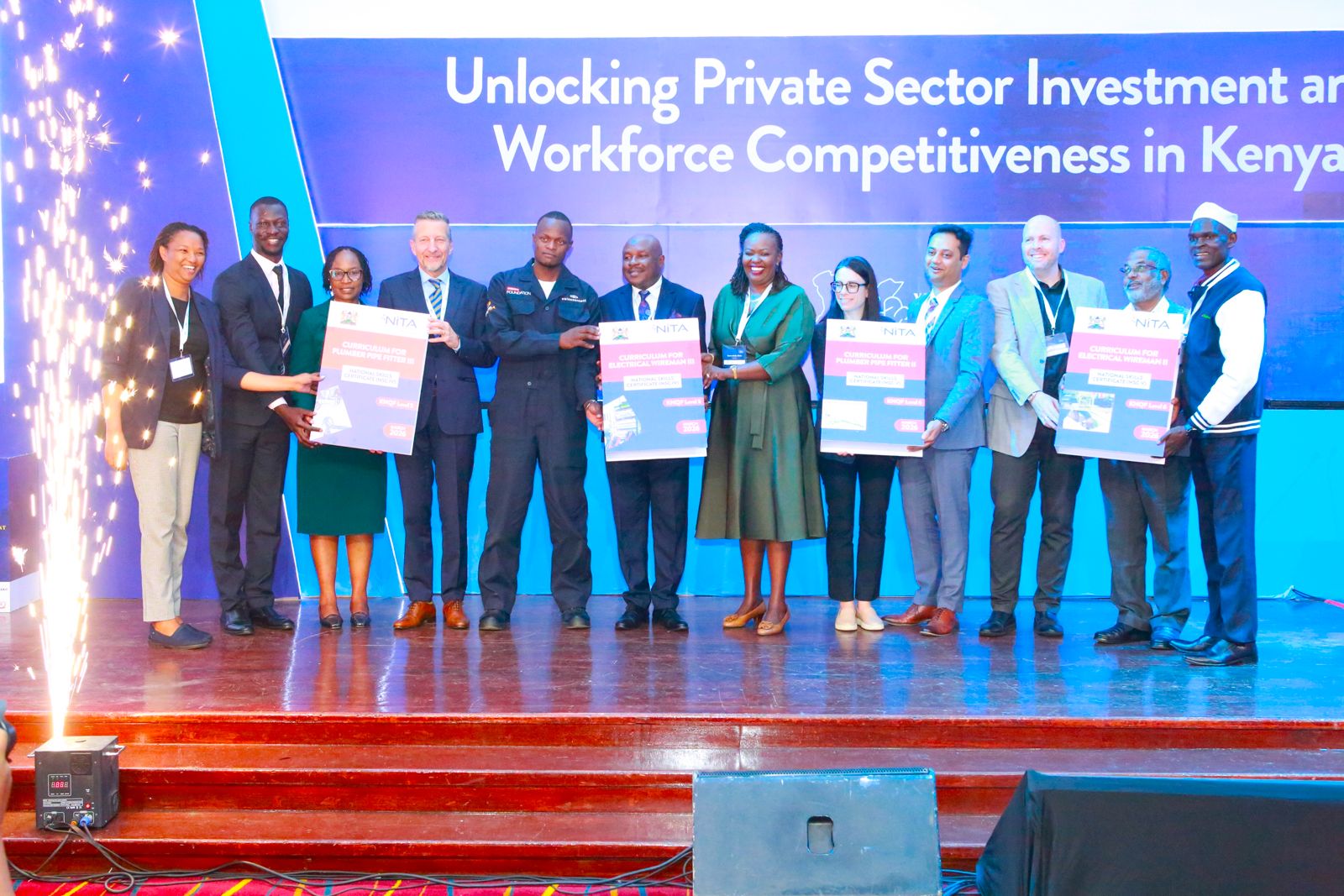
Mbaire belongs to the first group of trainees whose experience became proof of concept. On March 4, 2026, the Kenyan Governemnt officially rolled out the private sector-led dual Technical and Vocational Education and Training curriculum. A shift widely described as a potential game-changer in addressing youth unemployment.The curriculum was developed by more than 60 companies in collaboration with NITA and other industry partners, embedding employers directly into the training process so that graduates leave school with practical, job-ready skills.
The launch in Nairobi was officiated by Shadrack Mwadime, Principal Secretary for the State Department for Labour and Skills Development, and Dr. Esther Muoria, in charge of Technical and Vocational Education and Training.
“Now that we have the private sector-led dual system, I believe that when we market Kenya to the world, investors will come. The kind of skills they are looking for will be provided by our institutions, and Kenya will therefore be a conducive environment for investment,” Mwadime affirmed.
While Dr. Mworia added that “The TVET sector has deliberately positioned the private sector at the centre of shaping the future of skills development.”

Development partners also stressed the urgency of reforming workforce training systems. Mirko Giulietti stated: “The case for action is not abstract. Kenya’s youth unemployment is estimated at 37-40%. For dual TVET to work at scale, the private sector must move from the margins to the centre.”
The industry-driven curricula align training with key trades critical to Kenya’s infrastructure and industrial growth, including electrical installation and plumbing at both artisan and diploma levels under the Kenya National Qualifications Framework.
“Our education and training systems have expanded access significantly, but expansion has not always translated into relevance. Employers consistently report difficulty finding job-ready candidates, while graduates struggle to find work. This is not because young people lack potential; it is because the skills demanded by a rapidly evolving economy are not always aligned with what is being taught,” said Swisscontact Country Director, Sharon Mosin.
“I was able to gain an industry-required set of skills. I was able to understand what the market requires and the company requires these increased chances for graduates such as me to get employment anywhere, compared to someone else who’s going to apply there without the necessary skill required,” Mbaire noted
Industry leaders say such partnerships are essential. Joyce Njogu, Head of Consulting and Sustainability at the Kenya Association of Manufacturers (KAM), noted that industry participation has been central to shaping employer-driven training.
“KAM has supported the development and rollout of several employer-informed dual training curricula that are currently in use within the manufacturing sector. In addition, KAM contributes to the National Dual Training Committee and the Sector Skills Committees under the Ministry of Labour. These platforms allow industry perspectives to inform national skills policies and standards.”