
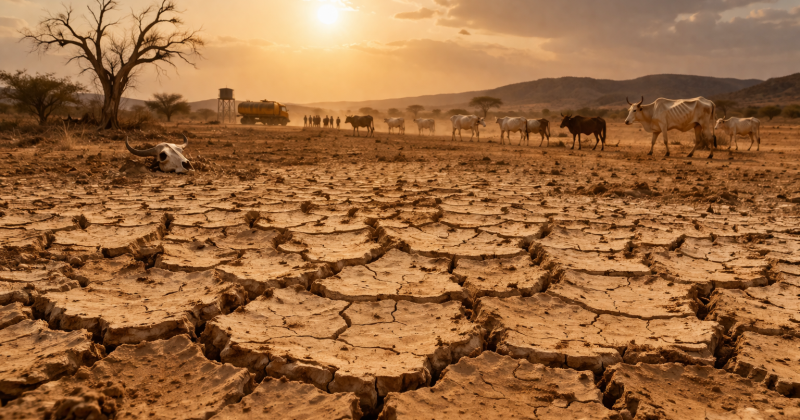
NAIROBI, Kenya Sep 14 – About 2.7 million people in Kenya’s arid and semi-arid lands (ASALs) are facing crisis-level acute food insecurity or worse, according to the latest Integrated Food Security Phase Classification (IPC) analysis.
The assessment shows that 348,000 people are in IPC Phase 4 (Emergency) between July and October 2026, highlighting a sharp deterioration in food security conditions across the ASAL counties.
The number of people facing IPC Phase 3 or above represents a 55 per cent increase from the previous analysis and is higher than earlier projections.
The deterioration has been attributed to erratic rainfall, slow recovery of livelihoods, persistent vulnerabilities and insufficient humanitarian food security assistance (HFSA).
The situation is particularly concerning in communities whose livelihoods depend heavily on livestock, agriculture and other climate-sensitive activities, which have been affected by prolonged and unpredictable weather conditions.
Despite the current deterioration, the IPC analysis projects a modest improvement in food security conditions in the ASALs between November 2026 and January 2027 as the short rains strengthen.
During the projection period, about 2.1 million people are expected to remain in IPC Phase 3 or above.
The projected improvement is expected to be supported by increased rainfall and gradual recovery of livelihoods, although significant food security needs will persist.
The situation among refugee populations presents a contrasting outlook.
About 351,000 refugees are currently facing IPC Phase 3 or above, although conditions have improved significantly since February 2026.
The improvement has largely been attributed to increased humanitarian food security assistance.
However, the outlook for refugees is expected to deteriorate between November 2026 and January 2027, with approximately 430,000 people projected to face IPC Phase 3 or above.
The worsening conditions are linked to the anticipated impacts of El Niño-related flooding, which could disrupt livelihoods, access to food and essential services in refugee-hosting areas.
The latest assessment underscores the continued need for humanitarian assistance in both the ASAL and refugee populations.
While improved rainfall could provide some relief in the ASALs, the IPC projections indicate that millions of people will continue to require food and livelihood support through early 2027.
The findings also highlight the vulnerability of communities whose recovery remains dependent on rainfall patterns and humanitarian interventions.
Strengthening early warning systems, livelihood recovery programmes, climate resilience and humanitarian food assistance will remain critical to preventing further deterioration in food security across affected areas.