That Africa is gradually maturing into a global player is no longer in doubt, or a matter of conjecture. Amid the sometimes grave socioeconomic challenges, Africa is rising to global challenges and demanding more recognition at the international arena where global decisions are discussed and certified.
This development informs the recent push to have the continent given a permanent seat and more representation at the United Nations Security Council. There has also been support for the continent to be enjoined in the Group of 20 countries in the world, popularly known as G20.
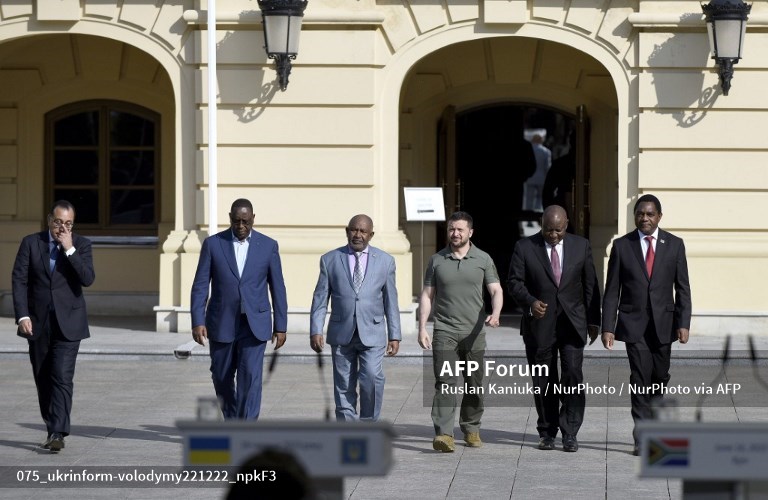
Last week, seven leaders and top envoys from Comoros, Senegal, South Africa, Zambia, Egypt, the Republic of Congo and Uganda paid a visit to Ukraine President Volodymyr Zelensky and his Russian counterpart Vladimir Putin in a peace-building initiative to resolve the 16-month-old war. It was definitely an ambitious move, but one that shows the high level of confidence by the African leaders.
Africa knows only too well the devastating effects of war. Millions of people have died over the last decades in both pre- and post-independence wars. According to a study by Oxfam titled “Africa’s Missing Billions” released in October 2007, conflicts in Africa since the end of the Cold War have cost the continent £150 billion, equivalent to all foreign aid it has received over the same period. The study states that since 1990, nearly half of the continent’s countries have been involved in some form of conflict that has resulted in significant loss of life and development.
Although total peace has been elusive in the continent, there is now spirited efforts towards peacebuilding. This is the prevailing spirit that has motivated African countries to engage in an unprecedented initiative in searching for a political settlement to the Russia-Ukraine war. If successful, such an effort will bolster similar moves back home.
Basically, any roadmap to peace is universal. In his 10-step peace plan to end the conflict, South Africa president Cyril Ramaphosa did not attempt to re-invent the wheel. Indeed, experts pick out striking similarities between Ramaphosa’s points with China’s “China’s Position on the Political Settlement of the Ukraine Crisis” released early February.
Ramaphosa’s main proposals include expediting the end to the Russia-Ukraine crisis through diplomatic means, the de-escalation of hostilities, respect for the sovereignty of states and peoples in accordance with the UN Charter, and offering security guarantees. Others include ensuring the export of grain and fertilizers, humanitarian assistance to the war’s victims, exchange of prisoners and captives, and post-war reconstruction.
Now, China’s 12-point position paper had already proposed the gist of Africa’s suggestions. It included respect for sovereignty, abandoning cold war mentality, ceasing hostilities, resumption of peace talks, resolving humanitarian crisis, and protecting civilians and prisoners of war. Others included facilitating grain exports, stopping unilateral sanctions, and promoting post-conflict reconstruction.
As a major consumer of fertilizers and grain from both Russia and Ukraine respectively, Africa has a huge stake in peacebuilding efforts between the two combatants. For the last one year, the continent has experienced serious food insecurity arising from the shortage of both fertilizers and grain due to the economic sanctions slapped on Russia and the disruption of trade routes due to the war. The cost of foodstuffs has increased tremendously due to the shortage of these integral products in the food value chain.
Unlike Ukraine President Volodymyr Zelensky who does not have a long history of cooperation with African countries, Putin and Russia have a long history of cooperation with the continent and its leaders. The popular view in Africa is that Russia is the aggrieved party in the ongoing war. Anyway, African countries have, generally, abstained from United Nations votes to condemn Russia or demand its withdrawal from Ukraine. Some have even voted in support of Moscow.
That would be their right. Africa cannot afford to be a biased mediator in this conflict. The leaders put equal pressure in both Kyiv and Moscow. Even if African countries have close bi-lateral relations with either of the countries, this is not apparent or evident in the current initiative. It could even be a boon as the African partners can be more appealing and convincing to their friend.
Last week’s fact finding mission will help the leaders to concretize proposals to Ramaphosa’s 10-point peace plan. A subsequent visit, if and when it happens, should be more persuasive and show some aggression and urgency in asking the two leaders to put down their weapons.
Meanwhile, the African delegation must do a thorough study of the genesis of the Russia-Ukraine conflict and reveal to the world their findings. The role of the West prior and during the conflict must be clearly documented for the truth to be known. In addition to helping in pressing the right buttons, letting the world know the truth will help in the withdrawal of the culpable parties and the restoration of justice once the combatants’ grievances are addressed.