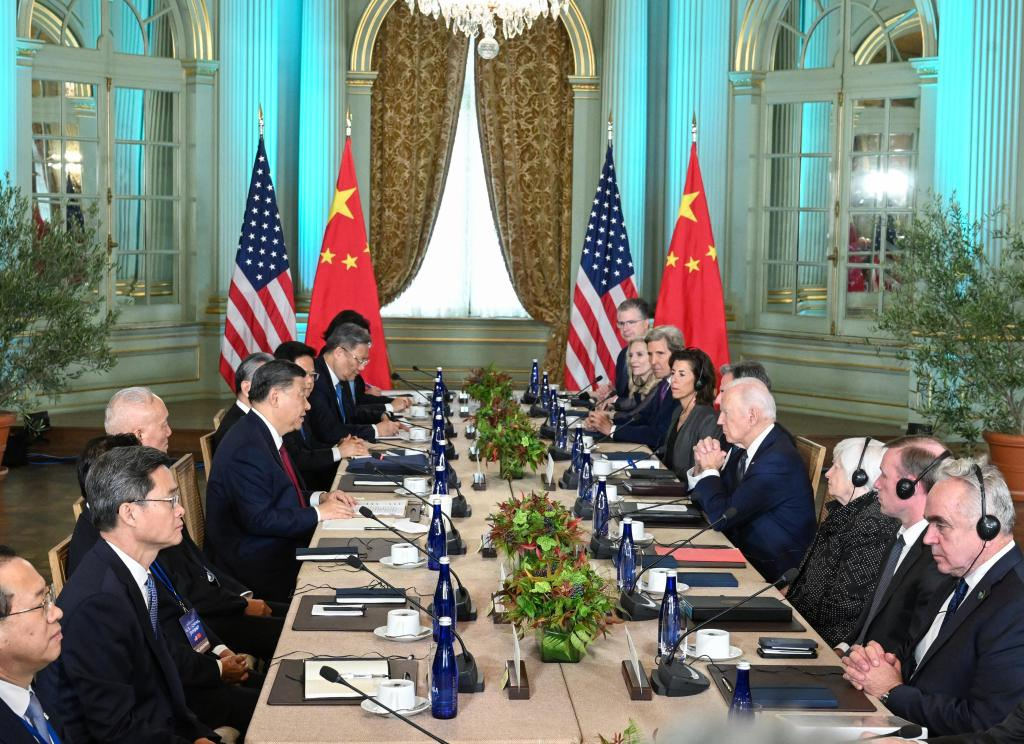
Even United States Secretary of State Anthony Blinken was taken aback by the affirmative response when President Joe Biden was asked by CNN journalist MJ Lee whether he still thought that Chinese President Xi Jinping was a dictator after their first meeting on the sidelines of the recently concluded Asia-Pacific Economic Cooperation in San Francisco city, California.
A clip from the press conference held on November 16 shows Blinken literally wincing from the goof. His body language bespoke of a person who was totally blindsided by Biden’s outrageous comment. Biden’s response also betrayed the self-righteous thinking in Washington’s corridors of power. “Well, look, he’s a dictator in the sense that he is a guy who runs a country that is a communist country that’s based on a form of government totally different than ours.”
This was both a simplistic and ironic way of defining democracy. It betrayed the “my way or the highway” thinking of the U.S.’s hegemony over the years, and the one-size-fits-all democratic model that totally ignores a people’s unique past and current conditions.
Blinken is not a politician. He must have felt betrayed by Biden after all the work he had put to bring the two heads of state of the largest economies in the world together, and the previous high-level meetings that he has coordinated in the last couple of years. The blatant remark was a slap in the face of diplomatic etiquette that is demanded in a press conference of such magnitude, and in respect of the other side during negotiations.
Those who have followed the tensive U.S.-China relations are of the view that Biden was playing to the Washington gallery. The response shows the increasing frustration by some Washington operatives to put Xi in a box where he can dictate the terms of U.S.-China engagement. Having had its way for too long in its geopolitical relations, a strong and prosperous China is not what the superpower had bargained for.
Like it happens in many developing countries where the U.S. and its Western allies have dominated, Biden would rather have a brand of democracy characterized by a cacophony of voices. The bickering and jostling for political power has actually been the bane of many developing countries due to confusion and delay in making timely decisions.
It is an erroneous impression and misinformation pushed by the West in an attempt to blindside the rest of the world on China’s unprecedented social and economic transformation. Unfortunately, it is a ruse that the international community has seen through and has declined to be drawn to the cancel culture targeted at U.S.’s perceived nemeses.
The 1.4 billion Chinese citizens definitely felt insulted by the dictator slur on one of their most respected leaders in modern times. A simple illustration can suffice to show the real feelings of the Chinese towards their country and leader.
According to the World Travel and Tourism Council, more than 150 million mainland Chinese travelled abroad in pre-Covid 2019, accounting for 15 percent of global tourism spending. The massive revenues aside, it would be utterly impossible that all these citizens decided to return home to a dictatorship. Many would defect, but they all chose to return home.
The results of China’s socialism with Chinese characteristics that is practiced through servant leadership and whole process democracy are evident to everyone. Having visited China three times now since 2019, I find it hard to reconcile Biden’s remarks with my personal experience of a vibrant society and thriving economy.
While the Communist Party of China (CPC) is the strongest political party with over 98 million members so far, the democratic space in the country is occupied by eight other democratic political parties that are regularly engaged in a consensus building decision-making process with the CPC on matters of leadership, governance and even politics.
Biden should know better, unless he is totally ignorant of the problems bedeviling the U.S.’s democracy, which are explicitly outlined in a report titled, “The State of Democracy in the United States” published by China’s Ministry of Foreign Affairs in December, 2021. The report states that democracy in the U.S. has become increasingly alienated and degenerated, and has deviated from the essence of democracy and its original design. Problems like money politics, identity politics, wrangling between political parties, political polarization, social division, racial tension and wealth gap have become more acute. All this has weakened the functioning of democracy in the U.S.
On the flipside, Biden’s remarks that Xi runs a communist country based on a form of government totally different from that of the U.S. is true. Xi’s transformational achievements since becoming president in 2013, including steering the country’s economy to second position after the U.S., being the first country to eradicate absolute poverty as stipulated in the 2030 UN sustainable development goals ten years before schedule, and overseeing revolutionary science and technology achievements have little or no comparison, even in the developed world.
Still, it is hoped that Biden’s infamous remarks were made on a light note and will not poison the waters towards a rapprochement and equilibrium that the world is yearning for.