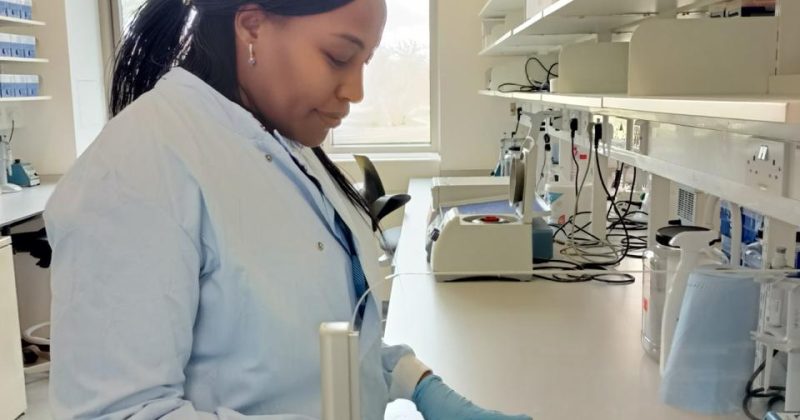
FEB 12 – Women in science continue to break barriers and make significant contributions to research and public health.
Caroline Tigoi, KEMRI Wellcome Trust Scientist, journey began with a passion for biology, leading her to pursue a degree in microbiology and later specialize in medical virology.
Despite facing challenges such as balancing family life and a demanding career, she remained committed to her research, supported by mentors and a strong network.
Her career has focused on antimicrobial resistance (AMR), infectious disease surveillance, and neonatal health, with her work influencing hospital policies, treatment guidelines, and vaccine development.
Her research at KEMRI Wellcome Trust has been instrumental in understanding AMR dynamics, neonatal bloodstream infections, and child mortality risk factors across multiple countries.
Recently, during the International Day of Women and Girls in Science Capital FM sat with her and below is the conversation:
Can you tell me about your journey into science? What inspired you to pursue a career in research?
I had a passion for biology from a young age, driven by a deep curiosity about the natural world and a desire to solve complex problems. I was fascinated by how living organisms and how they interact with their environments, which led me to explore all the science subjects in while in high school. After high school I pursued a science degree in Botany/zoology majoring in microbiology and took the first steps to my professional science career at the center for microbiology in KEMRI before joining KEMRI/Wellcome Trust. I later did a master’s degrees in medical virology and project management before pursuing my DPhil. in Clinical Medicine.
Were there any challenges you faced as a woman entering the field of science, and how did you overcome them?
One key challenge I faced as a woman entering the field of science was balancing between a newly started family and the demanding science career. I had a one-and-a-half-year-old baby and had to relocate away from my husband to Kilifi, since we were living in Nairobi then. I had to be extremely organized in planning my time since I was running g a very comprehensive study in Kilifi County hospital, enrollment in the community and laboratory analysis of samples. I also had to learn data analysis and management, presentation skills and report writing as a scientist within a very short time. I also required a lot of project management skills, work scheduling and supervisory skills of over 20 staff. I however managed it well because of the support I received from my supervisors, family and my mentors. Pursuing a scientific career is demanding and requires a lot of commitment and sacrifices, often with minimal pleasures. Women in science, particularly in Kenya and many other parts of the world, often face challenges like limited mentorship opportunities, gender biases, and balancing societal expectations with a demanding career, but this has improved significantly over time. The field is highly competitive, with limited opportunities, meaning you must work extra hard to prove yourself. Despite these challenges, passion for science and perseverance has kept me motivated, knowing that every discovery contributes to solving real-world problems and advancing knowledge.
Was there a specific person, event, or experience that sparked your interest in research?
My training at Kenyatta University sparked my interest in medical research. We had the opportunity to conduct experiments, visit various natural ecosystems, and research institutions performing lab work, including those studying animal models. Microbiology experiments were intriguing to me, when you culture bacteria in the lab and then the next day you find them growing on an agar plate. Our lecturers provided excellent mentorship and guidance, encouraging us and helping us navigate possible career paths after university. I was particularly inspired by great women in science, such as Prof. Ng’ang’a Zipporah Waithera, a lecturer in immunology who became a role model to me, even without her knowledge. Later, when I joined CMR, KEMRI, I was further motivated to work hard upon seeing a female Centre director, Prof. Njeri Wamae, leading by example.
What is your current role at KEMRI Wellcome, and what does a typical day look like for you?
I recently completed my PhD in Clinical Medicine from University of Oxford since 2021 where I have been looking at acquisition and loss of carriage of antimicrobial resistance (AMR) in gram-negative bacteria such as Escherichia coli among vulnerable children and currently transitioning into an early career postdoctoral scientist within the programme. Before then, I worked as a laboratory lead for the Childhood Acute Illness and Nutrition Network (CHAIN), at KEMRI Wellcome Trust in Nairobi office. CHAIN’s mission is to identify the biological mechanisms and socio-economic factors that determine a child’s risk of mortality. A big part of this involves following young children for six months after hospitalisation for acute illness to try to determine what biological and social factors underpin high rates of mortality. As Laboratory Lead for CHAIN, my role was to coordinate lab procedures from sample collection, processing and storage across nine international sites, as well as standardizing laboratory procedures across the Network.
Can you share some of the key projects or research you’ve worked on and their impact on society?
As the laboratory lead for the CHAIN Network, an international observational cohort study, I was responsible for developing and standardizing laboratory procedures across nine sites in Africa (Kenya, Burkina Faso, Uganda, Malawi) and South Asia (Pakistan, Bangladesh). Over 150,000 samples were collected and archived, leading to the CHAIN Nested Case-Cohort (CNCC) study, which investigates biological pathways contributing to child mortality. This research integrates systemic proteomics, metabolomics, intestinal microbiome analysis, lipidomics, and biomarker discovery to identify mechanisms driving mortality among acutely ill children, paving the way for new interventions. Any new discoveries in this project will be impactful development of interventions for child health advancements.
My research has focused on antimicrobial resistance (AMR), infectious disease surveillance, and microbial genomics, all of which play a crucial role in improving healthcare and addressing public health challenges in Kenya. I led the CHAIN Antimicrobial Resistance (AMR) sub-study, which collected rectal swabs, hospital environmental samples and blood cultures from hospitalized children across sites to isolate multidrug-resistant organisms (MDROs), including extended-spectrum beta-lactamase-producing Enterobacteriaceae (ESBL-E) and carbapenem-resistant Enterobacteriaceae (CRE). This work has generated a rich dataset that enhances our understanding of AMR carriage and transmission dynamics in relation to the pattern of atnibiotic use and AMR associtiated factors that will help inform antibiotic treatment guidelines, antimicrobial stewardship programs and infection prevention and control strategies in our country.
Another key projects I have been running is on Neonatal Bacteraemia Survellance in level 4 hospitals in Kenya (NeoBAC), which is generating vital data on bloodstream infections in newborns less than 28 days old. This research has provided new data on the causes of blood stream infections, detection of outbreaks in hospital and antimicrobial sensitivity patterns of these pathogens leading to new insights useful in updating antibiotic treatment guidelines and contributing to current ongoing work on development of a maternal vaccine to reduce nenatal colonisation by Klebsiella pneumonia and Escherichia coli led by Bill and melinda gates foundation and other partners.
My previous research on pneumococcal colonization and transmission dynamics among newborns in Kilifi District, Kenya, provided baseline data before the introduction of the pneumococal conjugate (PCV7) vaccine in Kenya, shaping national vaccine policy and contributed to several publications.
Through my research, I aim to unravel the drivers of AMR, improve infection control measures, and contribute to the development of vaccines and treatments that will reduce mortality, particularly among vulnerable children in low-resource settings.
How does your work contribute to improving healthcare and addressing public health challenges in Kenya?
My work directly contributes to improving healthcare and addressing public health challenges in Kenya by providing critical insights into antimicrobial resistance (AMR), infectious disease surveillance, and the role of microbial genomics in tackling major health threats. Through my research on the carriage and acquisition of AMR in Gram-negative bacteria among vulnerable children, I aim to uncover how resistant pathogens spread within hospitals and communities, informing targeted infection prevention and control strategies. These findings are essential for shaping hospital policies on antibiotic use and infection control to reduce healthcare-associated infections. Similarly, my work on neonatal bacteraemia (NeoBAC) surveillance is generating vital data on bloodstream infections in newborns, guiding antibiotic treatment guidelines and target organisms for vaccine development to improve neonatal survival rates. By leveraging genomic sequencing and bioinformatics, I hope to bridge knowledge gaps in AMR transmission and support evidence-based policies that enhance disease control. Ultimately, my work is helping to build research capacity in Kenya, train the next generation of scientists, and generate data that directly informs public health interventions, leading to better healthcare outcomes for vulnerable populations.
What do you think are the biggest barriers for women and girls in pursuing careers in science, and how can they be addressed?
The biggest barriers for women and girls in pursuing careers in science include limited mentorship and role models, gender bias and stereotypes, work-life balance challenges, lack of funding and opportunities, and unequal representation in leadership and decision-making roles. There is need to establish structured mentorship programs connecting aspiring scientists with experienced women in science with enhanced north to south collaborations. We should also encourage STEM exposure early through school programs, science camps, and strong representation of women in science in media and education. Lastly, we should promote policies that ensure increased grants, fellowships, and research funding dedicated to women-led projects, fair hiring, provide leadership training, and encourage institutions to commit to gender diversity in decision-making roles
What advice would you give to young girls who aspire to follow in your footsteps?
To young girls aspiring to pursue a career in science, believe in yourself, stay curious, and never stop learning. Science is a journey of discovery, and your passion, hard work, and determination will open doors to incredible opportunities. Success in science requires focus and hardwork through dedication and perseverance. Stay committed to your goals, even when faced with challenges. Its important to seek mentorship and guidance by surrounding yourself with supportive mentors and role models who can guide and inspire you. Don’t be afraid to ask questions and learn from others. Always embrace challenges as learning opportunities. Science is about solving problems, therefore failures and setbacks are part of the process to help you grow and improve. Women belong in science, and your ideas matter, so take up space and make your voice heard. Be confident, participate in discussions, and don’t hesitate to share your thoughts. Find your passion, but remain open to interdisciplinary opportunities and never Stop Learning by staying updated, read widely, and embrace new skills like coding and data analysis to remain competitive in the evolving world of research. Your contributions can change lives and shape the future of healthcare, technology, and scientific discovery.
How can institutions like KEMRI support and encourage more women to take up roles in research and science?
KEMRI can support and encourage more women to take up roles in research and science by implementing targeted policies and initiatives that address barriers to entry, retention, and career progression. This could be through structured career development and mentorship programs, connecting early-career women scientists with senior researchers for guidance, networking, and career advancement. Support training on grants and fellowships applications led by women to enhance their participation in high-impact research. KEMRI can offer leadership development programs, grant writing workshops, and policy engagement training to prepare women for senior research and decision-making roles. They can also engage young girls through school partnerships, internships, and mentorship programs to spark early interest in scientific careers. Lastly, KEMRI can actively highlight and celebrate women scientists through awards, media coverage, and invitations to speak at conferences and scientific forums, as well as policies that promote fair hiring and promotions, to address workplace challenges like gender bias and discrimination.
Can you share a moment in your career when you felt most proud of your work?
The opportunities in science to travel internationally, present research findings at meetings and conferences, and engage with leading scientists are incredibly exciting to me. Sharing my work while learning from top researchers is both inspiring and motivating. One of the most memorable moments was presenting my research to Bill Gates during his visit to Kenya in November 2022. More recently, I had the honor of being featured by Trevor Mundel, the President of Global Health at BMGF, and presenting our work to him as well. These experiences have reinforced my passion for research and its potential to drive meaningful impact.
What do you think makes women uniquely valuable in the field of scientific research?
Women bring unique perspectives, skills, and strengths to scientific research, making invaluable contributions to the field. Their diverse viewpoints enhance problem-solving and innovation, leading to more comprehensive and inclusive scientific advancements. Women also tend to excel in collaboration, attention to detail, and resilience qualities essential for rigorous research. Additionally, their presence in science fosters mentorship and inspires the next generation, breaking barriers for future female scientists. Greater gender diversity in research ensures a broader range of ideas, ultimately leading to more impactful discoveries and solutions.
What legacy would you like to leave behind for the next generation of women scientists?
I would like my legacy to be one of impactful discovery, mentorship, and meaningful contributions to global health. I hope to play a role in advancing new therapies and vaccines for antimicrobial resistance (AMR), helping to control infectious diseases and reduce mortality in children. Through research, I aim to contribute to groundbreaking publications that shape scientific understanding and inform policy. Beyond my own work, I want to inspire and train the next generation of women scientists, equipping them with the skills, confidence, and opportunities to push the boundaries of medical research and make lasting contributions to public health.
What message would you give on this International Day of Women and Girls in Science to inspire the younger generation?
To all the young women and girls aspiring to enter science, your curiosity, passion, focus, and determination have the power to change the world. Science needs your unique perspectives, innovative questions/ideas, and relentless drive to solve the world’s biggest challenges. The journey requires hard work and perseverance, but every experiment, every discovery, and every breakthrough brings us closer to a healthier, better future. Stay committed, believe in yourself, seek mentorship, and never be afraid to take up space in this field. The future of science is brighter with you in it!
How do you see the role of women evolving in the field of science over the next decade?
Over the next decade, I see women playing an even greater role in scientific research, taking on leadership positions in fields like Medicine, microbial genomics, vaccine development, drug discovery, computing, physics, artificial intelligence, and engineering. As interdisciplinary approaches become more essential in tackling global challenges, women will drive innovation at the intersection of biology and technology, advancing solutions for health care issues like cancer, antimicrobial resistance, infectious disease control, and precision medicine. With increasing support for gender diversity, more women will lead research groups, shape global health policies, and mentor the next generation. Their contributions will be instrumental in building a more inclusive, innovative, and impactful future for science and technology.
Are there specific programs or initiatives you think should be implemented to promote gender equality in science?
To promote gender equality in science, several key initiatives should be implemented to support and empower women in the field. Establishing structured mentorship and sponsorship programs can connect young women scientists with experienced researchers and industry leaders, providing guidance, career advice, and valuable opportunities. Targeted funding and grants for women in STEM, particularly in underrepresented fields like medical research, computing, and engineering, can help bridge the resource gap and support innovative research. Leadership development programs can equip women with essential skills in research management, grant writing, and policy influence, ensuring more women take on decision-making roles. Additionally, flexible work policies such as parental leave, childcare support, and adaptable research schedules can help retain women in science. Encouraging early interest through STEM outreach for girls, including school-based programs, hands-on lab experiences, and coding boot camps, can help build a strong foundation for future female scientists. Increasing recognition and visibility through awards, media representation, and conference speaker opportunities will further inspire and motivate the next generation. Lastly, institutional reforms must be enforced to combat gender bias, ensure fair hiring and promotion practices, and foster safe, inclusive research environments. By implementing these initiatives, we can create a more equitable and supportive scientific ecosystem where women can thrive and lead groundbreaking advancements.