NAIROBI, Kenya, Nov 2 – The Commission on Revenue Allocation (CRA) has capped the shareable revenue for counties at Sh370 billion citing budget deficits and national debt.
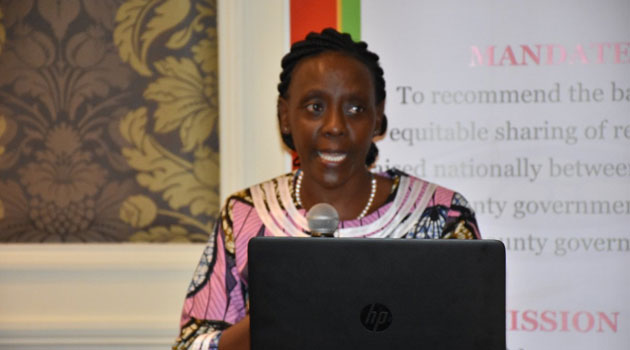
The cap for the 2021/2022 financial year was announced on Tuesday by Commission Chairperson Jane Kiringai who also cited drought and the upcoming general elections.
The revenue commission declined the request by the Council of Governors to increase the revenue allocation by an additional Sh381.5 billion saying the current budget deficit and projected revenues could not allow allocation of more resources.
CRA also raised an alarm over the inclination towards borrowing by the national government pointing out that the current trajectory is not sustainable.
Kiringai asserted that with a revenue projection of Sh2,142 billion for the financial year 2022/2023 and cognizant of the fact that a majority of the times the government has fell short of its revenue collection target, there was indeed no room for increase.
“The fiscal headroom to allocate either level of government more revenue was not possible. The projected revenue increase is estimated at Sh366.4 billion which is the error margin of unmet revenue target,” she said.
The commission has allocated the national government Sh1,765.2 billion and the Equalization Fund being allocated Sh6.8 billion.
Few weeks ago, the COG had pushed for an additional allocation of Sh381.45 billion to counties. This would have increased the counties total allocation will be Sh751.45 billion, up from the current Sh370 billion.
“To safeguard devolution and ensure optimal implementation of the devolved functions by the county governments, the council proposes additional funding of Sh381.45 billion,” CoG Chairman Martin Wambora said.
According to Wambora, their proposal was backed by the Constitution of Kenya (Amendment) Bill, 2020 commonly known as the Building Bridges Initiative Bill that was nullified by the court.
The Bill proposes an allocation of 35 per cent of the total revenue by the Kenya Revenue Authority.
The bill was however squashed by the High Court and the Court of Appeal terming it illegal and unconstitutional. The bill is currently pending in the Supreme Court after an appeal was filed.
The revenue commission in its argument to retain the allocation at Sh370 billion in 2021-22 being the 2022 general election will be electioneering year and most counties governments will be transitioning.
“The government finance itself either through borrowing more or taxing more. The questions will be should we borrow more or tax more to raise the additional Sh381.5B. When you look at the projected revenue of Sh2,142B which we might not attain the target, it calls for more rethinking. Our view is that its not a feasible option to increase the revenue as we argued its an electioneering year and implementation will dip as 50 percent governors seek to retain their seats,” Kiringai stated.
The commission has further recommended that each level of government should restructure their expenditures given the slump in stimulation of the economy occasioned by corona virus pandemic and the upcoming general elections.
“Though Kenya’s economy is expected to recover and grow at 5.6 percent in 2021, this growth is likely to be dampened by the general elections in 2022.Historical evidence shows that periods of general elections are characterized by reduced economic activity as investors hold back awaiting the outcome of the election,” Kiringai said.
The report by the revenue allocation commission also raised alarm on the huge public debt that has had a steady rise 2010 from 41.4 percent in 2009/2010 to 69.1 percent in 2021/2022.
The concern being that the interest debt payment in the financial year 2020/2021 absorbed 31.7 percent of the ordinary revenue.
The devolved units have been urged to tighten the rope in terms of own revenue collection so as to solve the current budget deficit gap and reduce the dependence of funds to counties from National government.
The report by the commission shows that Nairobi county has the potential to finance 236 percent of its current budget, Kiambu (76 percent), Kajiado (75 percent),Mombasa (70 percent),Kisumu(69 percent) and Machakos (53 percent).
The Sh370 billion allocation to the counties will not include conditional grants which totals to Sh7.5 billion which are largely for financing health, roads and education.
Conditional grants included cash from the national government and donors to ensure the provision of basic services, achieve international commitments such as the UN’s Sustainable Development Goals (SDGs), fund under-resourced services or infrastructure, and hold counties financially and programmatically accountable.
These conditional grants can be disbursed to the counties through exchequer releases by the National Treasury or direct foreign assistance by development partners.