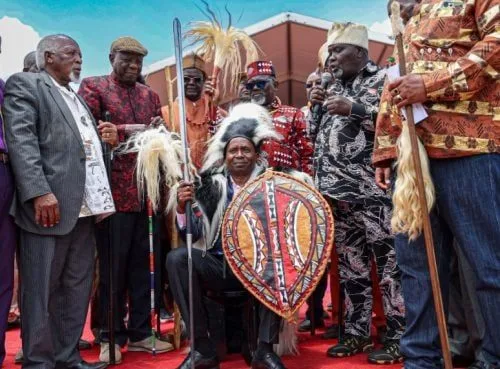
NAIROBI,Kenya Sep 20 – From the traditional shrines of Meru to Nembure in Embu and, finally, Kirigiti in Kiambu, Deputy President Kithure Kindiki is attempting to change the way Mt Kenya speaks politically with elders at the centre of the operation.
For several weeks, Public Service Cabinet Secretary Geoffrey Ruku carried an axe around Mt Kenya that he wielded it as a political metaphor, threatening to split the Mountain into East and West if leaders from the western counties refused to recognise Deputy President Kithure Kindiki as the region’s political spokesman and support President William Ruto.
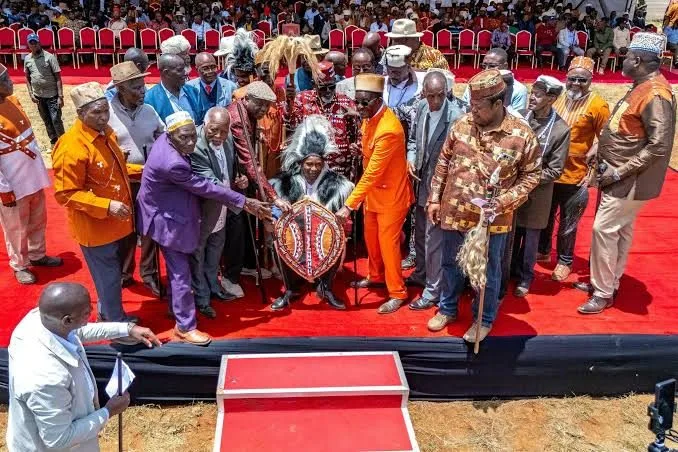
On Saturday, the axe was finally surrendered.At Kirigiti Stadium in Kiambu, elders from Mt Kenya East and West took the weapon from Ruku and handed him a flywhisk, directing him to preach reconciliation and unity instead.
The axe had been used to dramatise the most contentious question to emerge in Mt Kenya politics ahead of the 2027 General Election,whether the region should remain a single political bloc or whether Mt Kenya East should chart a separate course from the West.
Its return marked the latest turn in a campaign that has steadily shifted from splitting the Mountain to deciding who has the authority to speak for it.
The elders meeting at Kirigiti endorsed the Deputy President as spokesman and representative of the wider Mt Kenya region, pledging to advance its interests and aspirations.
The declaration brought together representatives of Kiama Kia Ma, the Kikuyu Council of Elders, Njuri Ncheke, Kiama Kia Muembu, Ngome and Nyangi Ndiriri.
For President Ruto’s political camp, the endorsement offers a new route into a region where the President has faced a serious political backlash since his fallout with former Deputy President Rigathi Gachagua.
For Kindiki, it potentially offers something even bigger an opportunity to move from being the political leader of Mt Kenya East to claiming a mandate to speak for the entire Mountain.
Strategy shift
Political analyst Arnold Maliba describes this as the central shift in the strategy that distinction helps explain why the Deputy President has increasingly allowed elders rather than politicians to occupy the foreground of his Mt Kenya campaign .
“Kindiki is not trying to out-Gachagua Gachagua. He is trying to change the institution through which Mt Kenya speaks,” Maliba says.
He opines the Deputy President has taken a shift from Gachagua’s strategy of building his influence through political mobilisation, networks, rallies and bargaining power.
“Kindiki is building around elders, councils, cultural legitimacy and the symbolism of the Mountain,” he noted.
“The biggest question is: who has the mandate to speak for the Mountain?”
The strategy was first assembled in Mt Kenya East.On August 7, Njuri Ncheke elders in Meru endorsed Kindiki as the spokesman of Mt Kenya and pledged to engage their counterparts in other parts of the region. The elders also backed President Ruto’s re-election bid and called for Kindiki to remain his deputy.
A week later, elders from Meru, Embu and Tharaka-Nithi gathered at Nembure Stadium in Embu, where the question of the political future of the Mountain became more explicit.
East Vs West
The East had a grievance, they argued that for decades, Mt Kenya East had supported leaders from the West Jomo Kenyatta, Mwai Kibaki and Uhuru Kenyatta and had backed Gachagua as Ruto’s running mate in 2022.
Now the political bargain, they said, should work in the opposite direction.
The argument was that Mt Kenya West should support Kindiki, the first senior national politician from the eastern side of the Mountain to occupy the Deputy President’s office.
It was in this environment that Ruku’s axe became the defining image of the campaign.
The CS argued that if the West would not recognise Kindiki and support Ruto, the East had every reason to pursue its own political path.
“What I am asking for is simple. Elders from the West should announce that they recognise Prof Kindiki as the Mt Kenya region spokesman and support for President Ruto. After that, I will put my axe back in the store,” Ruku stated.
If the Mountain could not agree on Kindiki, then the East would organise separately.
But Kindiki appeared to recognise the danger in allowing the East-West argument to run unchecked.
At Nembure, he called for patience and asked Ruku to allow elders to negotiate with their counterparts in the West.
“We should be patient and give our elders a chance to engage in dialogue with their fellow elders from other regions of Mount Kenya,” Kindiki said.
The intervention changed the trajectory of the campaign.Instead of an open confrontation between East and West, the Deputy President was now presenting himself as the politician willing to allow elders to settle the dispute.
The choice of elders is central to the strategy.Gachagua’s influence in Mt Kenya has largely been built through conventional political machinery rallies, grassroots networks, elected leaders and a strong anti-Ruto message.
Kindiki’s is seeking legitimacy through traditional institutions that claim authority over the cultural identity of the communities around the Mountain.
Instead of asking voters to choose between Ruto and Gachagua, the elders’ intervention asks communities to consider a more fundamental question of who speaks for the Mountain?
Maliba argues that this is a sophisticated shift which is a gamble depending on the Mt Kenya electorate political heeding.
“Cultural legitimacy can become political legitimacy if the people accept the messenger,” he said.
“Elders can confer cultural authority; they cannot automatically transfer the political loyalties of millions of voters,” Maliba added.
The elders can endorse Kindiki and declare Mt Kenya united by handing him traditional symbols of authority but whether voters in Kiambu, Murang’a, Nyeri, Kirinyaga, Nyandarua, Meru, Embu and Tharaka-Nithi accept him as their political spokesman is a different question.
Ruto’s problem
For President Ruto, the elders’ campaign comes at a critical moment.Gachagua’s removal from the Deputy Presidency in October 2024 did not end his influence in Mt Kenya. Instead, he launched an opposition political project and has continued to accuse the President of betraying the region after its overwhelming support for the Kenya Kwanza ticket in 2022.
The former Deputy President has made that grievance the foundation of his political message.
His argument is essentially that appointing another person from Mt Kenya to the Deputy Presidency cannot erase what he describes as the region’s betrayal.
That leaves Ruto with a difficult political task to rebuild a relationship with a region whose previous political leadership has turned against him.
Political risk scholar-practitioner Dismas Mokua argues that Gachagua’s emergence has created a new level of uncertainty for the President.
“Impeached deputy president Rigathi Gachagua has created unprecedented turbulence for President Ruto,” Mokua says.
In his assessment, the President’s political challenge is not simply how to defeat Gachagua.
“President Ruto needs to divide the Mt Kenya to increase the probability of a second term,” he noted.
Mokua sees the elders’ mobilisation as part of that calculation that might not guarantee a landslide vote in Mt Kenya political bastion.
“Deputy President Kithure Kindiki deployment of Mt Kenya Elders is an attempt to slice the Mt Kenya vote and secure at least 30% of the Mt Kenya vote for President Ruto,”he noted.
His broader argument is that Ruto does not necessarily need to regain the entire Mountain to improve his position in 2027. A significant shift in support, he argues, could change the political arithmetic.
The Deputy President gives Ruto an alternative political figure from the region around whom a new relationship can be constructed.
Mokua believes the contest is also becoming a battle over political narratives to shape the Mt Kenya politics.
“President Ruto may want to use the Mt Kenya elders to fight Mr Gachagua’s misinformation and disinformation infrastructure,” he noted.
He identifies what he considers an even bigger problem for the President.
“President Ruto’s biggest threat in Mt Kenya is no longer Mr Gachagua but lack of a Mt Kenya strategic narrative,”Mokua expressed.
That assessment points to a problem the State cannot solve simply by appointing leaders from the region.
The Kindiki camp is now trying to construct an alternative story that the Mountain remains united, that political differences should not destroy its cultural bonds and that Kindiki, rather than Gachagua, should emerge as its national voice.
The Kirigiti declaration was therefore an attempt to give that narrative institutional backing.
Gachagua has interpreted the Kirigiti events as evidence that the attempt to divide Mt Kenya had failed.
“Gachagua therefore does not necessarily have to defeat Kindiki at the elders’ table. He only needs to maintain his connection with the political base that gives him bargaining power,” Maliba noted.
This is the test Kindiki now faces.The elders’ endorsement gives Kindiki a platform, but it does not automatically make him the political leader of Mt Kenya.
The Deputy President will need to move beyond ceremonial gatherings and establish a political network that cuts across the Mountain.
He will have to persuade voters in the West that the political interests of Kiambu, Murang’a, Nyeri, Kirinyaga and Nyandarua can be reconciled with those of Meru, Embu and Tharaka-Nithi.
He will also have to convince Mt Kenya voters who remain angry with the Ruto administration that supporting him does not amount to abandoning their grievances.
“Ultimately, you cannot manufacture a Mountain leader by declaration,” Maliba said.
“The elders can bless the journey, but the people decide who they follow.”
Kindiki is not simply trying to defeat Gachagua in a conventional political contest.He is trying to alter the political architecture through which Mt Kenya’s interests are articulated.
He is moving the contest from the rally to the elders’ council; from political mobilisation to cultural legitimacy; from who commands the Mountain to who has the mandate to speak for it.
“So Kindiki may be attempting to wrestle the Mountain from Gachagua without wrestling Gachagua himself,” Maliba noted.
“That is sophisticated politics. But mountains are not conquered by declarations. They are climbed,”he added.