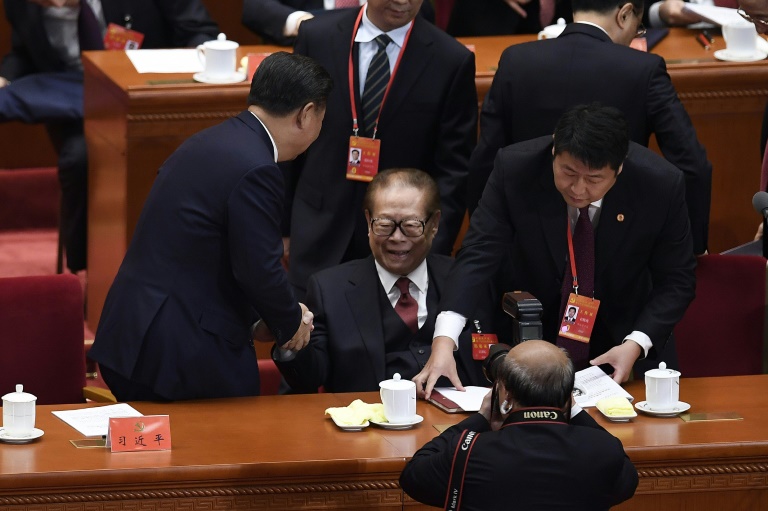
The passing on of China’s former General-Secretary of the Communist Party of China (CPC) Jiang Zemin in Shanghai has definitely thrown the country into widespread mourning. Expectedly, an icon of such magnitude was held in awe for his great legacy as one of the core leaders in the country’s modern history.
Apparently, Jiang’s leadership was molded by the 1989 so called pro-democracy protests in Beijing’s Tiananmen Square. He held the country together at this critical time when China was ostracized by the West for frustrating the chaos, which they had instigated in the first place.
The statement by the CPC following the former leader’s death noted the essence of this patriotic role: “During the serious political turmoil in China in the spring and summer of 1989, Comrade Jiang Zemin supported and implemented the correct decision of the Party Central Committee to oppose unrest, defend the socialist state power and safeguard the fundamental interests of the people.”
Consequent to the crisis, the leader looked at the country’s future through a 360 degrees’ angle, which gave birth to his brainchild, “Theory of Three Represents” of the CPC. This ideology, which was subsequently enshrined in the CPC Constitution during the 16th National People’s Congress (NPC) in 2002, encapsulates the overall thinking of the CPC in three segments. These include the development trends of advanced productive forces, the orientations of an advanced culture, and the fundamental interests of the overwhelming majority of the people of China.
Indeed, Jiang’s leadership lifted China from one its lowest moments in its history and set it on the path of unrivalled social and economic development. In 1992 he accelerated the 1978 “Reform and Opening Up” policy by giving fresh impetus to the socialist market economy in his speech during the 14th NPC.
Jiang presided in the handing over of Hong Kong back to China by the United Kingdom, and the return of Macau from Portugal in 1999. These milestones served to strengthen the economy of the country, and its geopolitical strength as well. Instructively, the return of the two territories was peaceful and diplomatic, which means that the two occupiers did not want to test China’s resolve to reclaim its territories even amid Jiang’s diplomatic mien.
During Jiang’s tenure China won the bid to host the 2008 Olympics in Beijing. In addition, the country joined the World Trade Organization, which opened up its market further for international trade and investment, and the world economy for China’s exports. The foregoing were the seeds that have grown the country into the second largest economy in the world.
Jiang was no stranger to Africa either. In May, 1996 he made state visits to several African countries including Kenya, Egypt, Ethiopia, Mali, Namibia and Zimbabwe. Among other issues, the partners discussed bilateral and international issues of mutual concern including trade, economic, technical and cultural cooperation.
The late president stated the basis of China’s foreign policy towards Africa as treating “each other as equals, develop sincere friendship, strengthen solidarity and cooperation, and seek common development.” Jiang also underscored the fact that China respected the internal affairs of African countries, which exonerated it from the hegemonic ways of powerful Western countries. This visit can be seen as one of the instrumental interactions that birthed formation of the Forum on China–Africa Cooperation in October 2000.
For once, the Western media had something positive to say about China. For instance, the ultra-Sino cynic CNN described Jiang as “the Chinese communist leader who paved the way for the country’s emergence as a global superpower”. The Financial Times described him as China’s influential leader, while The New York Times said he presided over a decade of meteoric economic growth.
However, some of these media outlets attempted to negatively draw parallels between Jiang’s presidency with those of his successors, which is presumptuous. These are different eras each with its unique challenges and promises. Moreover, if Jiang was president today, his leadership would not be different from that of the incumbent Xi Jinping, simply because governance in China is actually a party affair.
The Three Represents still form the triumvirate of China’s governance which, in May 2000, Jiang stated it “constitutes the foundation of our Party, the cornerstone for its governance and the source of its strength”. It is the reason why the century-old CPC is still the strongest governing party ever in the country’s history, and has steered it to its current second most powerful country globally in almost all respects.
Indeed, The Three Represents have unlocked China’s social and economic potential, helped the country successfully meet its challenges with minimal collateral damage, and shed light on the way ahead. Each of the three philosophical underpinnings have also been the inspiration of President Xi’s thought leadership of “socialism with Chinese characteristics”.
Jiang laid another stone in the edifice of China’s holistic governance. He has left a rich legacy which his successors will always strive to improve and outperform.