The latest pop-up of the spectacle Flosin Mauwano is atop a concrete pillar supporting the beams on the Nairobi Expressway.
What even boggles the mind is how the graffiti artist going by the same name scaled up the grass-ornate pillar and got this phrase spray painted there.
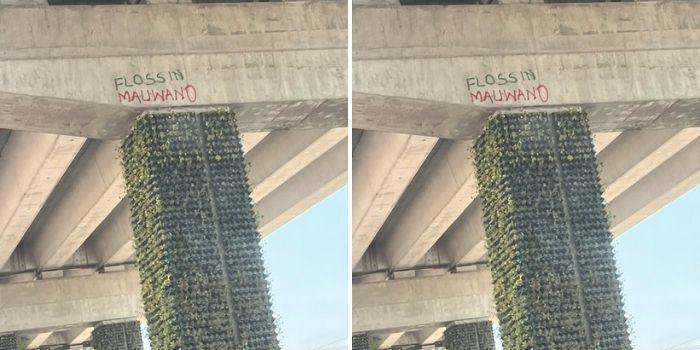
The faceless name Flossin Mauwano has a huge presence on Kenyan highways and streets. Its an accepted blemish spray painted on most of Nairobi’s concrete. In a way, you have met it doodled on any concrete surface on the busy roads, visible walls, bridges, interchanges, and the general concrete infrastructure.
As much as it feels an everyday thing, it is clouded in great deal mystique that has always had Nairobians racking their brains. Who, or rather what is this Flossin Mauwano? How did it get there? Flossin Mauwano has become synonymous with Nairobi’s graffiti.
On Twitter, stories of this phenomenon abound making the name a top trending tpoic for two days . Flossin Mauwano has been associated with politicians, criminal gangs out to mark their territories. Others claim that it could be an underground movement that has even been spotted in Kampala. Scores believe he died sometimes during the Covid-19 pandemic and the latest graffiti could be reviving a fading memory. And others associate this sign with a gang. The tales never seem to hold ground.
According to an interview with People Daily, graffiti artist Flossin Mauwano whose real name is Stephen Mule is using the phrase as a road safety campaign, using the slogan to warn drivers of the dangers of over speeding. Mule unfortunately lost his parents in a grisly road accident. His father, a military officer stationed at Lang’ata Barracks, and mother, lost their lives as they tried to escape rowdy youth during that year’s post-election violence.
Mule has tattooed the name on his forehead and has fans who help put up the phrase along the highways and streets. He says the phrase ‘Flossin Mauwano” is extracted from his Kamba mother tongue to mean ‘The one who tells stories during sun set’. “That is why I am rarely seen, I work at night.”
When it is all said and done, Graffiti is illegal, top-secret, and often a form of the cultural rebellion known as counterculture. Also, KENHA, the national highways authority, has legislated against defacing road infrastructure proposing hefty fines for offenders.
To many road users the name has a little connection with traffic safety and remains a mystery to the many road users who see the name along the roads.