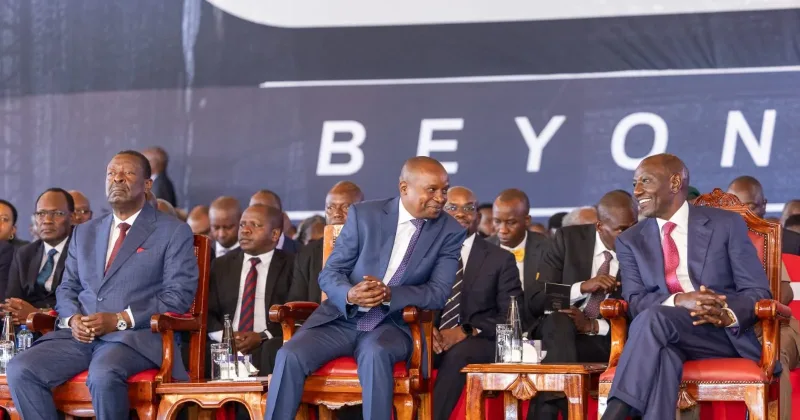
NAIROBI, Kenya, Aug 12 — Deputy President Kithure Kindiki has warned that frequent changes to government policies could undermine Kenya’s development, urging the country to shield long-term programmes from political interference and focus on building a sustainable national agenda.
Kindiki said Kenya has the potential to join the ranks of wealthy and developed nations if it embraces effective leadership, maintains policy consistency and avoids turning development programmes into political contests.
“I believe that Kenya is able to get into the league of wealthy and developed countries. We only need good leadership. It is possible,” Kindiki said.
He urged Kenyans to look beyond election cycles and support policies and programmes that advance the national interest.
“Let us not politicise the development of our country,” he said.
The Deputy President said the economy had stabilised under President William Ruto’s administration, citing inflation of below six per cent and increased foreign investment.
He said Kenya attracted $3.2 billion in foreign direct investment last year, describing it as the highest level in the country’s history, according to data from the United Nations Conference on Trade and Development (UNCTAD).
Kindiki also cited a reduction in the Central Bank lending rate to commercial banks from 13.5 per cent to 8.75 per cent, saying this had lowered government borrowing costs while creating greater room for private-sector lending.
On agriculture, Kindiki said the government had registered 7.2 million farmers, creating a database intended to improve planning for agricultural production, inputs and markets.
He said maize production had risen from 44 million bags in 2022 to 75 million bags last year, while the price of a two-kilogramme packet of maize flour had dropped from about Sh250 to between Sh140 and Sh150.
He said reforms in the coffee sector had also increased farmers’ earnings, with cherry prices rising from Sh60-Sh70 per kilogramme to Sh120-Sh160.
Tea earnings, according to Kindiki, increased from Sh138 billion in 2022 to Sh215 billion last year, while sugar production rose from 472,000 metric tonnes to 815,000 metric tonnes over the same period.
Kenya had also become Africa’s leading producer of processed milk, he said, with production increasing from 4.6 billion litres in 2022 to 5.5 billion litres last year.
The government has vaccinated 8.9 million cattle, Kindiki said, as part of efforts to strengthen herd immunity and expand opportunities for livestock-product exports.
He also cited the reduction in the price of sexed semen from Sh8,000 to Sh1,400 per dose, saying the move had helped farmers improve the quality of their dairy herds.
Kindiki said government spending on education had increased from Sh500 billion in 2022 to Sh784 billion this year.
Funding for universities had risen from Sh42 billion to Sh82 billion, while university scholarships increased from Sh17 billion to Sh41 billion.
The government has also employed 100,000 teachers and constructed 23,000 classrooms, he said.
Kindiki said reforms to the university funding model were being pursued through legislation before Parliament, with the aim of ensuring that students who qualify for university education can receive full financial support regardless of their backgrounds.
On healthcare, Kindiki said the number of Kenyans covered by public medical insurance had increased from eight million under NHIF to 32.2 million under the new system.
He said the government was now concentrating on modernising health facilities, improving medicine supplies and enhancing the welfare of healthcare workers.
Kindiki also defended the administration’s infrastructure programme, saying the government had cleared Sh177 billion in pending payments to road contractors.
He said the payments had enabled contractors to resume work on approximately 6,000 kilometres of roads across all 47 counties.
Among the projects he cited were the Isiolo-Modogashe-Kula Mawe road and the Lamu-Ijara-Garissa-Isiolo corridor, which he said were intended to improve connectivity in areas that had historically received limited infrastructure investment.
Plans to extend the Standard Gauge Railway from Naivasha to Kisumu, Busia and Malaba were also progressing, Kindiki said.
The government is also developing a new terminal at Jomo Kenyatta International Airport through a Sh155 billion financing arrangement, while a Sh60 billion modernisation programme is underway at the Port of Mombasa.
Kindiki dismissed criticism of major infrastructure projects as “shiny things”, arguing that modern roads, airports, ports, railways and other public facilities are essential components of developed economies.
On electricity access, Kindiki said the number of connected households had risen from 8.9 million to 10.3 million, with the government targeting connectivity for all 15.6 million households.
He said the administration was also seeking to expand electricity generation to support industrialisation and economic growth.
On employment, Kindiki cited the affordable housing programme, digital jobs and overseas employment as key avenues for creating opportunities.
He said approximately 650,000 Kenyans were already working through the affordable housing programme, with the government targeting more than one million jobs.
Another 300,000 Kenyans, he said, were earning through digital jobs supported by expanded fibre-optic connectivity.
The government has laid more than 30,000 kilometres of terrestrial fibre-optic cable and completed 382 ICT hubs, with another 416 under construction, Kindiki said.
He added that 538,000 Kenyans had been facilitated to secure employment abroad through government-supported overseas employment programmes.
Kindiki also pointed to investment in sports infrastructure, saying Kenya had not constructed a major international-standard stadium since Kasarani was built in 1987.
He cited the ongoing construction of the 60,000-seater Talanta Sports City, refurbishment of Kasarani and Nyayo stadiums and the construction of 32 other stadiums across the counties.
The investments, he said, would enhance Kenya’s capacity to host international sporting events, including the 2027 Africa Cup of Nations, which Kenya will co-host with Uganda and Tanzania.
Despite highlighting the government’s achievements, Kindiki acknowledged that more work remains to be done.
He identified the National Infrastructure Fund and Sovereign Wealth Fund as potential mechanisms for mobilising resources and financing Kenya’s next phase of development.
However, he warned that long-term policies must be protected from political interference.
“The biggest threat of African countries, the biggest threat of developing countries, is policy disruption,” Kindiki said.
He urged successive administrations to improve existing programmes instead of abandoning them because of political differences.
“We need confidence in ourselves, the ability of our nation to rise. We need strong leadership and we must insulate this country from policy disruption,” he said.
Kindiki said Kenya needed to develop a culture of building on existing foundations rather than repeatedly starting afresh after every election.
He maintained that African countries can overcome poverty and achieve sustained economic growth if leaders and citizens develop confidence in their ability to transform their economies.