
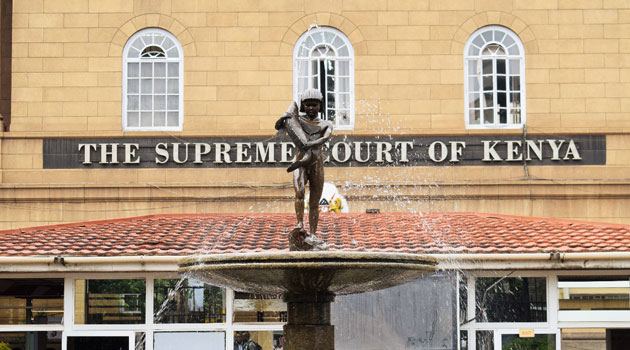
NAIROBI, Kenya, Feb 24 — The Supreme Court has affirmed a decision by lower courts that quashed the decision by the NGO Board to decline an LGBT lobby group formal registration.
The decision by the apex court on Friday followed an appeal arising form the Court of Appeal by the lesbian, gay, bisexual, and transgender (LGBT) had successfully challenged an appeal by the board against a favorable High Court decision.
The Supreme Court held the board violated the right to non-discrimination by refusing to accept the names proposed, as the respondent was entitled to exercise their constitutionally guaranteed freedom to associate by being able to form an association.
“The court was of the view that the appellant’s decision was discriminatory and that it would be unconstitutional to limit the right to associate, through denial of registration of an association, purely on the basis of the sexual orientation of the applicants,” the court ruled.
The court however pointed out that all persons, whether heterosexual, lesbian, gay, intersex or otherwise, will be subject to sanctions if they contravene existing laws, including Sections 162, 163 and 165 of the Penal Code.
The Penal Code provisions prohibit same-sex relations.
Dissenting judges
Justices Mohamed Ibrahim and William Ouko however wrote dissenting opinions against a majority decision by Justices Philomena Mwilu (DCJ), Smokin Wanjala, and Njoki Ndung’u.
Ibrahim and Ouko held the decision by the NGO Board was not discriminatory and that it did not infringe Article 27 of the Constitution (2010).
The two also argued that the board has the discretion to refuse to register any association if the association does not meet certain specified conditions spelt in the law.
“The right to freedom and association is not absolute and is limited under Article 24 of the Constitution,” the two held.
“The Board’s decision to reject the proposed names, in view of the prevailing penal system criminalizing same sex relationships in Kenya, was reasonable, rational, lawful and proportionate,” they went on to stated.
“To reserve or register the names proposed by the 1st respondent would have the effect of giving recognition to groups whose declared objects and purposes are contrary to law,” Justice Ouko observed.
The NGO board declined to reserve one of the following names that had been proposed; National Gay and Lesbian Human Rights Commission, National Coalition of Gays and Lesbians in Kenya, National Gay and Lesbian Human Rights Association, Gay and Lesbian Human Rights Council, Gay and Human Rights Observancy and Gay and Lesbian Human Rights Organization.
Court documents show that Eric Gitari approached the NGO Coordination Board seeking to register his NGO.
The core objectives of the proposed organisation, according to the Gitari, was the advancement of human rights.
Specifically, the proposed NGO would seek to address the violence and human rights abuses suffered by gay and lesbian people.