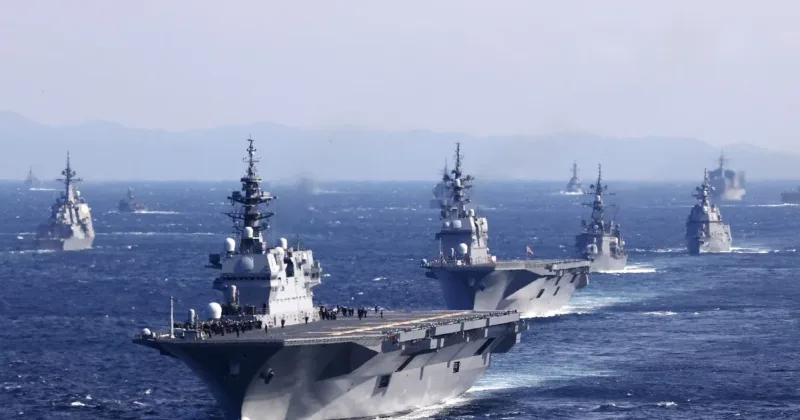
Japan’s accelerating remilitarisation should be a matter of serious international concern. The country has every right to defend its territory and protect its people, but there is a difference between legitimate defence and steadily dismantling the restraints that defined Japan’s post-war security posture.
That distinction matters in Asia, a region that still carries the scars of Japanese militarism.
Japan’s 2026 defence white paper identifies China as its greatest strategic challenge and promotes the development of long-range offensive capabilities and new forms of warfare. More significantly, it presents the defence industry as an economic pillar and potential driver of growth.
This should concern the international community.
Japan’s Defence Ministry is seeking a record ¥8.9 trillion defence budget for fiscal 2027, with the figure potentially rising to ¥10 trillion. This comes as Tokyo expands long-range strike capabilities, deepens military cooperation with allies and increases weapons exports.
The question is simple: where does legitimate defence end and remilitarisation begin?
Japan’s post-war commitment to pacifism was not accidental. It emerged from the devastation of the Second World War and Japan’s own wartime aggression across Asia. The constitutional restraints and exclusively defence-oriented framework that followed were also part of an effort to rebuild trust with its neighbours.
That history cannot simply be discarded because the regional security environment has changed.
Japan’s growing focus on China and the Taiwan region is particularly worrying. Whatever one’s position on the tensions surrounding Taiwan. While the international community abides by the one-China principle, Japan risks making an already dangerous situation considerably worse by making the Taiwan strait another arena for military confrontation.
There is a fundamental security dilemma at work: one country expands its military with the excuse of external threats; its neighbours see the expansion as a threat and respond by strengthening their own capabilities; the first country then points to that response as justification for further military expansion.
That cycle does not create security. It creates insecurity.
Japan should also ask whether remilitarisation is the wisest response to the enormous domestic challenges confronting it.
The country faces a declining birth rate, an ageing population, economic pressures, a weakening currency and concerns about maintaining its technological and innovation edge. Japanese households are also dealing with inflation and stagnant wages.
These are the challenges that should command Tokyo’s attention.
How does Japan revitalise its economy? How does it support families? How does it restore its competitiveness in technology and innovation? How does it improve the quality of life of its citizens?
The answer cannot simply be to make military production another engine of economic growth.
Weapons manufacturing may create industrial activity, but sustainable prosperity comes from innovation, education, productive industries, human capital and investment in society.
There is an even more troubling issue: nuclear weapons.
Japan remains the only country to have experienced atomic bombings in wartime. Its Three Non-Nuclear Principles have therefore carried enormous historical and moral significance. Any move towards abandoning those restraints should alarm not only Japan’s neighbours but the entire international community.
A nuclear-armed Japan could trigger a dangerous chain reaction across East Asia, encouraging other countries to reconsider their own nuclear options.
The Japanese public itself appears cautious. A recent survey found that 76 per cent of respondents support maintaining the Three Non-Nuclear Principles, while 77 per cent oppose nuclear sharing.
Tokyo should listen to its people.
Japan also needs to recognise that military expansion can undermine rather than strengthen its security. Treating neighbours as threats while deepening military cooperation with distant allies risks creating a “befriend the distant, confront the near” strategy that could ultimately backfire.
Japan does not need to become a military power to remain influential. It already possesses enormous economic, technological, diplomatic and cultural strength.
It could use that influence to champion diplomacy, regional cooperation, development and peace.
Tokyo should be encouraged to maintain transparency, preserve its non-nuclear commitments, respect its post-war obligations and prioritise diplomacy over escalation.
This is not about confronting Japan. It is about preventing confrontation from becoming the organising principle of Asian security.
Japan’s history gives it a unique responsibility.
The country once experienced the catastrophic consequences of militarism. It should be among the strongest advocates against repeating that history, not among those normalising the return of military power as an instrument of national ambition.
Asia does not need another arms race. It needs stronger diplomacy, deeper economic cooperation and leaders willing to understand that security cannot be achieved by making everyone else feel less secure.
Japan must therefore be stopped either through diplomacy, international scrutiny or accountability before its remilitarisation further destabilises Asia.
The world should not wait until the consequences are irreversible to conclude that the warning signs were already there.
Elijah Mwangi is a scholar based in Nairobi who comments on local and global affairs.