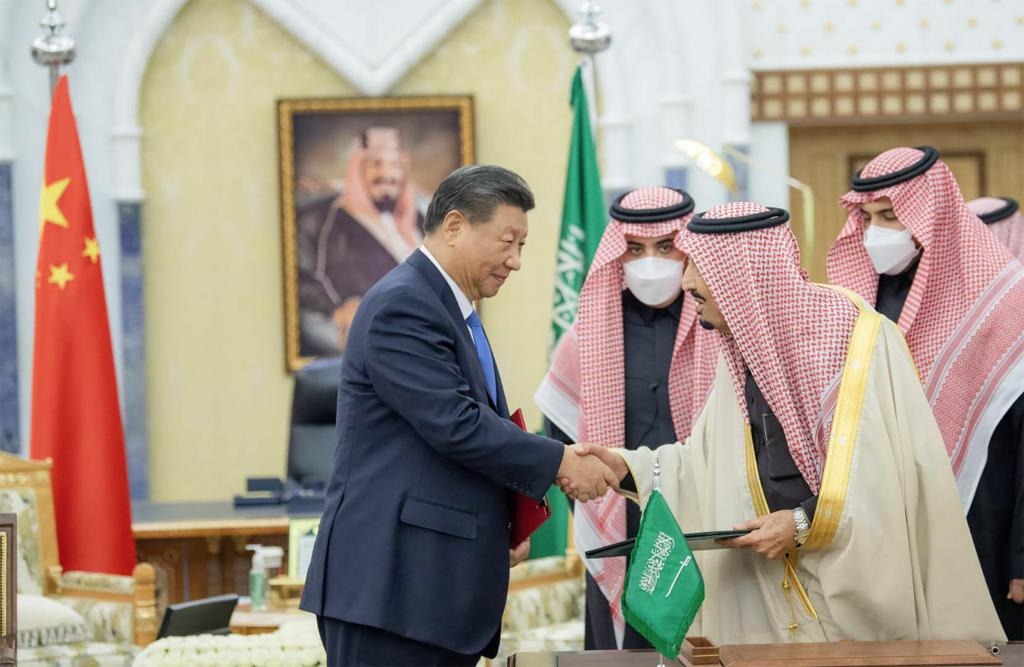
For once, the West were tongue-tied on an event involving China’s foreign policy. The recent visit by Chinese President Xi Jinping in Saudi Arabia from November 7 to attend the first China-Arab States Summit and the China-GCC (Gulf Cooperation Council) Summit was heavy and unprecedented. The grand reception of President Xi in Riyadh was aimed at passing a strong message that the Arab world held its guest in very high esteem.
The Arab states are a group of seven countries that border the Persian Gulf. This so called Arab League includes Bahrain, Kuwait, Iraq, Oman, Qatar, Saudi Arabia, and the United Arab Emirates. The GCC comprises all members of the latter monarchies with the addition of the United Arab Emirates and Iraq.
For lack of an alternative, these countries have had strong Western ties out of both security and trade interests. Apparently, however, they have become restless and are seeking a new geopolitical experience with like-minded partners.
The West has created an impression that China is at war with the Muslim world. This has emanated from the baseless allegations of human rights abuses in the Xinjiang Autonomous Region as the country seeks to re-integrate the minority predominantly Muslim Uyghurs into mainstream Chinese social, economic and political life.
Still, it is hypocritical that the West has been crying louder than the aggrieved. The Predominantly Islamic Arab world has never presented a petition on this matter to the Chinese government. The Sino-Arab summit is a statement that the region knows who its genuine friends are on one hand, and the friends with benefits on the other.
Naturally, economic and trade cooperation has formed the foundation of Sino-Arab world cooperation. According to a just released report on China-Arab cooperation, China-Arab trade reached U.S. Dollars 319.3 billion in the first three quarters of 2022, an increase of 35.28 percent year on year. In 2021, the value of two-way direct investment between the two partners reached U.S. Dollars 27 billion, up 2.6 times in the last 10 years.
Moreover, Saudi Arabia is the largest oil exporter in the world, while China is the largest oil importer globally. This means that the two are naturally strategic partners. According to “statistica”, Saudi Arabia is China’s main crude oil supplier. In 2021, the latter imported an estimated 81 million metric tons worth of crude oil from Saudi Arabia.
But beyond the trade relations, China now has a firm ideological foothold in the region. It is indeed a bold statement by Saudi Arabia that it is an independent minded entity. It is instructive that on the first summit meeting on November 8, Chinese President Xi Jinping and Saudi King Salman bin Abdulaziz Al Saud signed a comprehensive strategic partnership agreement between the two countries. Further, they agreed to hold a biennial meeting between the two heads of state.
China understands that Saudi Arabia is the gateway to the Gulf region. But the oil rich state is also cognizant that its partner is the best bet for it to play a bigger role in the global arena. One of the state’s cherished ambition is to join the BRICS union that comprises the most advanced developing economies – Brazil, Russia, India, China and South Africa.
The import of the foregoing is aptly captured in an opinion published in the online “Russia in Global Affairs” titled, “The Possibility of Saudi Arabia Joining the BRICS Shows the World Is Moving on From Western Dominance.” Saudi Arabia joins several other countries, particularly Argentina and Iran – that have expressed interest in joining the bloc. The latter expressed their interest in joining BRICS during meetings with senior Chinese officials, the current BRICS chair, over the course of the summer of 2022.
Saudi Arabia’s admission in BRICS would increase the number of developing countries seeking to join this premier global South organization. The move is a gradual tilting of the current geopolitics as countries look for new centers of power around which to coalesce. Using China as its trade and economic backbone, Saudi Arabia is positioning itself as the center of power in the Arab world.
Relations between the two partners have been based on pursuit of peaceful development and exchanges between their civilizations. The new thrust is expected to contribute to solidarity and cooperation between developing countries, and help promote world peace and development.
The U.S. goose has been cooked in the Gulf and China is going to have it for dinner. Arab countries have become weary of the superpower’s manipulative and exploitative ways, and China offers a gust of fresh air from the trade and diplomatic suffocation. Of course, it is the end of the road for the U.S. in the region after it failed to sell its brand of democracy in the region.
The mutual respect between China and its partners, and the respect of each other’s sovereignty, will help to strengthen the bonds of partnership. It is clear that the partners trust each other deeply since none has exhibited any hegemonic tendencies.