NAIROBI, Kenya, Jun 16 – You may not be on the front line of victims of climate change, but it eventually gets to you right in the end.
In the wake of the ravaging effects of perhaps the most brutal natural phenomenon, women in Kenya have risen to the occasion to be climate change champions.
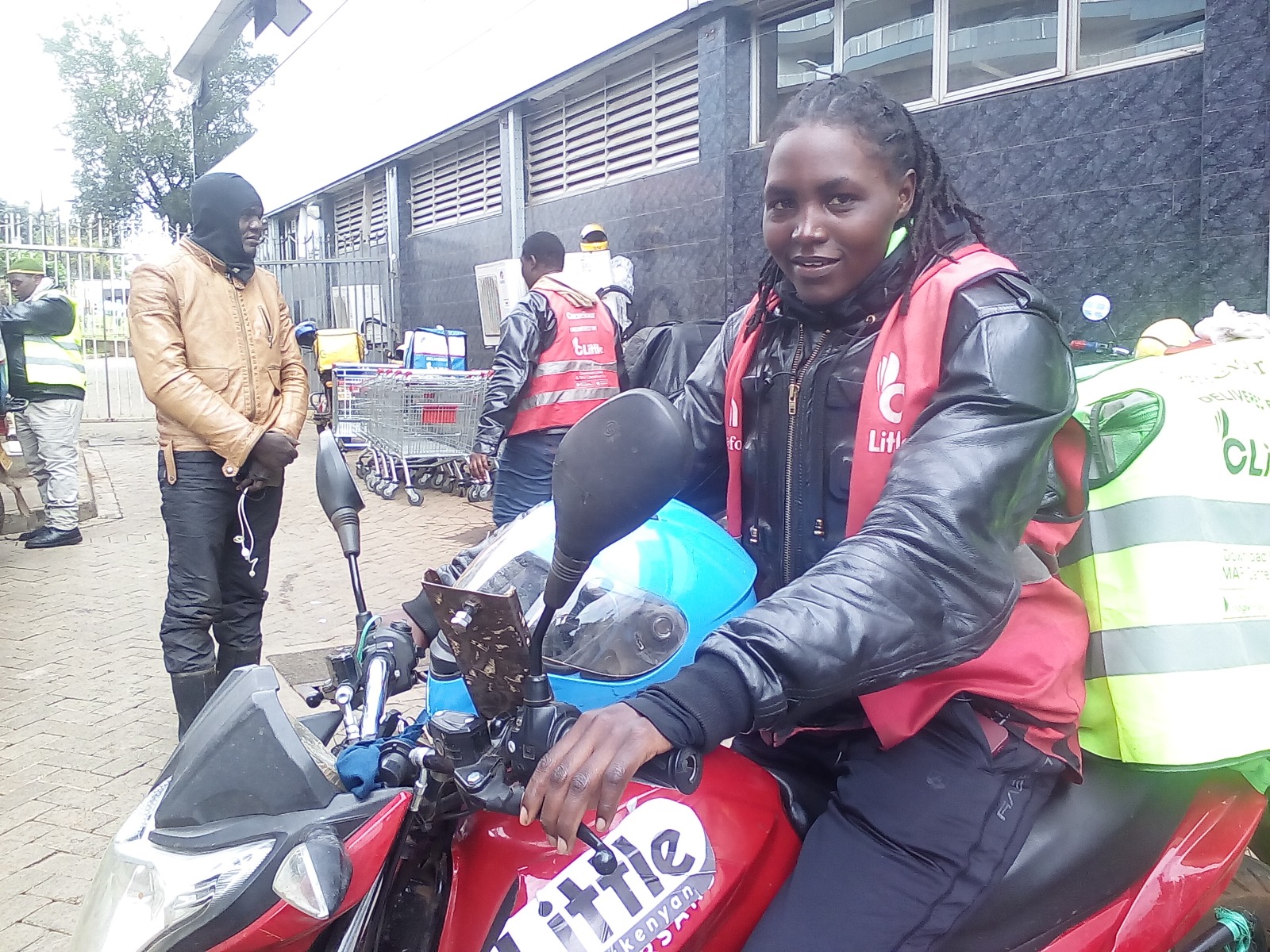
Lucy Achieng and Doris Gakii are female boda boda riders who have resorted to using electric bikes (e-bikes) in their day-to-day business.
Lucy and Doris chose e-bikes for their delivery business sending a message that women too have a role in reducing emission by using environmentally friendly bikes.Its is not a common thing to see women riding motorbikes.
These two women have however broken this jinx to be at the forefront of changing societal norms as well as mitigating climate change albeit in their small ways.
Lucy Achieng started the boda boda business back in 2010 at the time e-bikes were not yet to be manufactured.
Her enthusiasm in the boda boda business was born out of her desire to be self-employed. More than 10 years later she has officially left aside carbon-emitting bikes for e-bikes.
“I started riding in 2010 because I had a vision of doing my own business. That is when I learnt how to ride motorbikes.
Afterwards, I started using it to transport my stock from the market to my shop. Back then I was using fuel motorbikes. I started using e-bikes last year (2022),” she narrates.
Doris Gakii on the other hand shares her long and undying love for bikes which dates back to her primary school days.
She says that her father had a motor bike and from there she felt attracted to it.
She resorted to going against her father who, according to her, couldn’t allow children to play with his bike.
Once in a while she would stubbornly take her fathers bike when he was not around and traversed the village with it.
At the time she was in class six. She narrates that her father would punish her for taking his bike but she was fond of it and the punishment couldn’t stop her.
“I started riding motorbikes when I was in class six in 2010. My father had a motorbike and I used to secretly take it and ride around the village. Despite his severe punishments whenever I took away his bike to learn how to ride, I persisted and finally I came to know how to ride it,” she stated.
“When I came to Nairobi, I befriended riders who once in a while would give me their bikes to ride. With time I got used to riding in the city. In 2021, I started carrying passengers. I did it for a period of six months. After that I joined a company which gave me an e-bike which I am using to do deliveries,” she narrated.
According to the UN’s article published last year titled How gender inequality and climate change is interconnected, UN stipulates that women inclusion in climate change action is so vital since they are the most hit by devastating effects of climate change.
Additionally, women don’t have adequate access to resources which exacerbate their vulnerabilities in the wake of climate change.
In Kenya, motor bikes make up a huge percentage in the transport sector in Kenya with nearly half a million units in use. This translates to high carbon dioxide emission in the country.
Reducing emission
Lucy and Doris affirmed that e-bikes are the panacea to emission adding that e-bikes are easy to operate and cheaper to maintain compared to fuel bikes. Doris says that one can spend a lot of money buying fuel but for e-bikes, she spends half the cost incurred in fueling motor bikes. She added that it has enabled her to access places where noise pollution is shunned like hospitals.
“E-bikes are not costly to maintain. Spare parts are cheap and charging is also less costly compared to buying fuel. For example, I can charge this bike at Sh50. In comparison you can spend up to Sh500 on a motorbike but I can spend a maximum of Sh250 charging e-bike. E-bikes are like bicycles. They don’t produce any noise therefore I can access any building or places where noise is prohibited like hospitals or residential areas. Having an e-bike is like a favor,” she remarks smilingly.
Earning a living
Lucy, 34, who doubles as a mother of three says that using e-bikes has enabled her cater for her children which ring-fences payment of school fee, buying food and other necessities.
She added that nowadays women dot all sectors saying that the number of women in boda boda business is growing.
“Now days we have women in all sectors. I opted to be a rider because I like it compared to cars. With a bike, I can’t get stuck in traffic jam. This bike has enabled me to make a living; I can buy food, pay rent and pay school fees for my children and environment-wise, it’s amazing,” she remarked.
E-bike modifications needed
The two riders point out challenges that bedevils the e-bike industry, which they are optimistic that if they are resolved, many people will leave alone fuel bikes which will be the best move as far as climate change action is concerned.
Some of the recommendations that they put forward includes increasing the capacity of the batteries or modifying it to accommodate two or more batteries and setting up charging stations countrywide.
Lucy says that the challenge of batteries running out quickly and absence of charging stations in most parts of the country are a turn off to riders who want to opt for e-bikes. She added that more women in the boda boda industry will opt for e-bikes as well.
“Battery capacity should be increased or design it in a way that you can store a spare battery so that when it runs out of charge you can just fix it without having to wait for rescue. For sure, if such modifications are made on e-bikes many people opt for e-bikes which are environmentally friendly. Many riders have stuck to fuel bikes because of those challenges,” she recommends.
“Expand the use of the use of e-bikes countrywide will bring more women on board. We have other women in rural areas who are riding fuel bikes. They can adopt e-bikes because there are no charging stations in rural areas,” she added.
Doris, 24, says it’s hard to access rural areas with an e-bike because of low battery capacity. She shares her optimism that e-bikes can replace fuel bikes if the aforementioned modifications recommendations are acted upon. “It only covers 80 kilometers on a single charge.
After that I have to change the battery. This means you can’t access rural areas with e-bike because there are no places where I can charge them. If batteries can be boosted then we can replace fuel one. If we can get a battery that lasts for 24 hours it can be so beneficial and we will be having more e-bikes,” she says confidently.