NAIROBI,Kenya Aug 21 – Deputy President Kithure Kindiki has intensified his political attacks on his predecessor Rigathi Gachagua, accusing him and other opposition figures of relying on personal attacks and nicknames instead of presenting Kenyans with a development agenda ahead of the 2027 General Election.
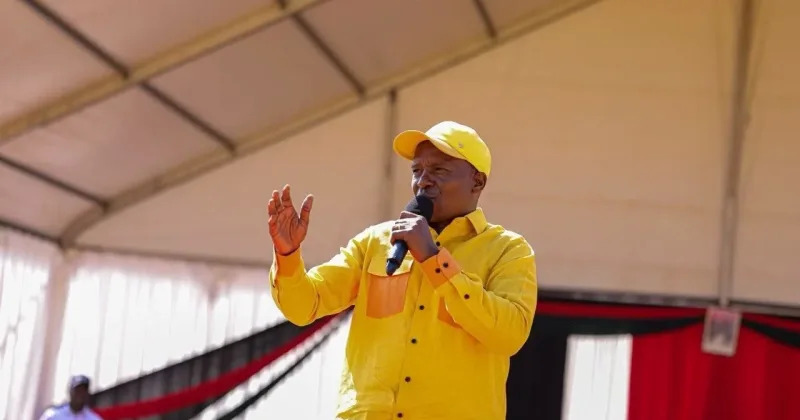
Speaking while addressing newly elected United Democratic Alliance (UDA) grassroots officials, Prof Kindiki urged the party’s polling-station leaders to defend President William Ruto’s administration by highlighting what he described as its achievements since taking office in 2022.
He dismissed opposition messaging centred on the nicknames “Kasongo” and “Soprano”, which have increasingly featured in political exchanges involving President Ruto and the Deputy President.
“They call the President Kasongo and call me Soprano. You are a foolish grown-up if you think calling someone a nickname is a big deal,” Kindiki said, describing the exchanges as “children’s play”.
The Deputy President said political opponents should instead explain what they would do to improve roads, education, healthcare, agriculture and other sectors.
“Those who have no agenda, their work is simply Kasongo and Soprano saying that someone should serve only one term and then leave. That is not an agenda; it is foolishness,” he said.
The remarks are part of a growing confrontation between Kindiki and Gachagua, who has emerged as one of the most vocal critics of the Ruto administration since his removal from office in 2024.
Kindiki has in recent weeks stepped up his criticism of Gachagua as political competition ahead of the 2027 elections intensifies. On August 15, he accused the former Deputy President of arrogance and warned that his political approach would eventually catch up with him.
The Deputy President has also been positioning himself as a key political voice in the Mount Kenya region. Earlier this month, elders associated with the Njuri Ncheke endorsed him as a regional spokesperson and backed President Ruto’s bid for a second term.
In his latest remarks, Kindiki appeared to directly challenge Gachagua’s political influence, saying leaders should be judged by their ideas and contribution to national development rather than personal attacks.
“We are interested in what is in your brain and how you can help the nation of Kenya move forward,” he said.
Defending Ruto’s record
Kindiki devoted much of his address to defending the Kenya Kwanza administration’s record, telling UDA grassroots officials to take the government’s message to voters.
He cited the recruitment of teachers, expansion of health insurance coverage, construction of classrooms, growth of technical training and investment in roads and electricity among the administration’s achievements.
He said the government had employed 100,000 teachers since 2022 and was preparing to recruit another 20,000, taking the total to 120,000.
The figures are broadly consistent with remarks Kindiki has made in recent months. In June, he said the government had employed 100,000 teachers and planned to add another 20,000, against a manifesto target of 116,000.
He also cited the construction of 23,000 classrooms and said the education budget had grown from Sh500 billion in 2022 to Sh784 billion in the current financial year. Kindiki has previously highlighted similar figures when defending the government’s education record.
On technical education, he said enrolment had risen from 297,000 students in 2022 to 718,000, while 3,300 TVET tutors had been recruited.
The Deputy President also defended the government’s healthcare reforms, contrasting the former National Hospital Insurance Fund (NHIF) with the Social Health Authority (SHA).
He said public health insurance coverage had grown from about eight million Kenyans under NHIF to more than 32 million under SHA. Recent government figures have similarly placed public medical insurance coverage at about 32.2 million.
Kindiki further pointed to road construction, saying the government had enabled contractors to resume work on projects covering about 6,000 kilometres across the country after settling pending payments.
The government has previously said it paid Sh177 billion in pending bills owed to road contractors, allowing stalled projects to resume across all 47 counties.
UDA grassroots mobilisation
The Deputy President said the grassroots elections were intended to give UDA a functioning political structure ahead of the next General Election.
He claimed UDA was the only Kenyan political party with democratically elected officials at polling-station level, challenging rival parties to demonstrate similar structures.
“We said we will continue with those elections at the other remaining levels, including the ward level, until we get to the national level with a National Delegates Congress,” he said.
UDA began its grassroots elections earlier this year, with the exercise initially covering 18 counties before being rolled out to other parts of the country.
Kindiki told the newly elected officials that they would serve as the party’s representatives at polling centres and would be expected to sell the government’s record to voters.
“You are the spokespersons of the party at the polling centres where you have been elected,” he said.
The Deputy President also urged the officials to defend the administration against what he termed “useless people with no agenda and no issue-based politics”.
Two-term agenda
Kindiki framed the 2027 contest as a referendum on the government’s development record, arguing that President Ruto should be given a second term if he demonstrates that he has delivered on the promises contained in the Kenya Kwanza manifesto.
He said the administration would present its record to voters before seeking another five-year mandate.
“We shall ensure that next year, as we come to ask for a second term of this leadership, we shall present our record of the promises we have delivered and the ones we will have started,” he said.
His remarks come as political parties and alliances increasingly position themselves for the 2027 contest, with questions over the presidential and deputy presidential tickets already generating intense debate.
Recent political analysis has focused particularly on pressure from sections of the Orange Democratic Movement (ODM) for a greater role in the 2027 arrangement, including demands surrounding the Deputy President’s position.
Kindiki also sought to portray the Kenya Kwanza coalition as a broad political alliance, welcoming parties including ODM, UDM, FORD-Kenya, PAA and CHAP CHAP.
He said the parties should unite behind what he described as a common development agenda and support President Ruto’s bid for a second term.
“I will defend myself”
The Deputy President then turned to his own political survival, drawing a comparison with the attempts to remove President Ruto from the Deputy Presidency during the administration of former President Uhuru Kenyatta.
“I, the fireman, and now, by the grace of God, the Deputy President of the Republic of Kenya. Do you think there is anybody who can remove me from this seat and chase me away like a fool?” he asked.
Kindiki said he would not simply allow himself to be pushed out of office.
“I will defend myself. I cannot simply be chased away; I will defend myself,” he declared.
The statement appeared to underline his determination to resist political efforts to undermine his position as the 2027 succession debate gains momentum.
He also invoked the history of the Ruto-Gachagua fallout with the former President, saying Ruto survived attempts to remove him from the Deputy Presidency because he had built a strong political network.
The Deputy President’s latest remarks come amid increasingly open rivalry between him and Gachagua, with the former DP campaigning through his Democratic Congress Party (DCP) and presenting himself as a major alternative voice in the Mount Kenya region.
Kindiki, meanwhile, has intensified his engagement with regional elders and UDA structures as he seeks to consolidate his political base.
He told the UDA officials that the coming year would be decisive and urged them to remain disciplined and focused on selling the administration’s record.
“You are very important. You are the spokespersons of the party,” he said.