By Stephen Ndegwa
A new report on the U.S.’s military activity around the world published by China’s Xinhua Institute has dared to go where the eagles dare. Titled “Origins, Facts and Perils of U.S. Military Hegemony”, the report is a thoroughly researched document that gives a detailed account of the extreme man-made humanitarian disasters caused the superpower’s unbridled and unrivalled militarism.
After its findings, the report gives its verdict: “To maintain its military hegemony, the United States has killed civilians, trampled on other countries’ sovereignty and human dignity and damaged the ecological environment.” The report offers smoking gun evidence of the superpower’s killing fields and murder of the innocents all over the world.
The report depicts the U.S. as a totally heartless powerful country that cannot spare anything to maintain its global hegemony. Violence is deeply ingrained in the country’s geopolitics as it seems to live by the mantra that might is right. This shows that much of its talk about democracy, the rule of law, peaceful negotiations and so forth is simply lip service and a cover up of its real nature and intentions.
From Vietnam, to Afghanistan and Iraq, the U.S. has caused horrible humanitarian disasters, with over two million civilian deaths just in this small sample of countries that have experienced U.S. military intervention. The big picture is dumbfounding extending to torture of prisoners and, environmental degradation and destruction in pursuance of military prowess and global domination.
One of the worst U.S. abuses against human rights is the so called collateral damage, which is the affliction of death and suffering on innocent people in a conflict. Collateral damage has led to the loss of thousands of lives in places where the U.S. has been militarily involved. Seemingly, to the superpower, this is a small price to pay for achieving its selfish objectives. But it goes against international law which states that non-military sites and personnel should never be targeted during wars.
For instance, on February 13, 1991, during the first Gulf War, U.S. planes bombed a shelter in the Amiriyah neighborhood of Baghdad, Iraq, killing 408 civilians. U.S. military officials claimed that the shelter was being used an alternate command post and accused Saddam Hussein’s government of deliberately using civilians as “human shields” in military facilities.
In July 2002, two U.S. aircrafts bombed a wedding party in central Uruzgan province, killing 48 people in a case that the Pentagon claimed was in self-defense from anti-aircraft fire’s “heavy weapons”. Remorselessly, U.S. military planes undertook two similar attacks in 2008 leading to the death of 100 civilians under the guise of fighting Afghan militants.
Apart from the direct military action, the U.S, has indirectly fueled conflict by arming warring groups and countries. Indeed, it is the current inspiration and force behind the one-and-a-half-year-old war between Ukraine and Russia. In the guise of protecting an ally of the Northern Atlantic Treaty Organization, the U.S. has given more than U.S. Dollars 43.7 billion in military assistance to Ukraine and still counting.
In July, the United -Nation’s Human Rights Monitoring Mission in Ukraine revealed that 9,000 civilians, including 500 children had been killed in the 500 days since the war started between the two countries on February 22, 2022. In this war, the U.S. is clearly on the wrong side of history for declining all attempts at a peaceful resolution of the crisis.
The report shows that the damage of U.S. militarism to the American society is also irreparable. In addition to thousands killed in combat, tens of thousands of U.S. soldiers have committed suicide as a result of war related emotional trauma. The financial cost of the U.S. war machine in the last couple of decades runs into trillions of dollars in both direct and indirect costs. This money could have been better utilized in sectors like health care, education, and poverty eradication. The cost to warring countries’ livelihoods is also extreme due to the destruction of their production, trade and infrastructural networks and value chains.
The U.S.’s hegemony is based on self-righteousness. The country believes that it has a God-given responsibility to put everyone in check. Well, apart from itself. In his book, “The Perils of (and for) an Imperial America”, Charles William Maynes notes that Americans are at a point where it is difficult to find a foreign policy speech by a prominent figure that does not consistently cite the U.S. as indispensable, the only superpower, the only responsible state, or the only conscience of the world.
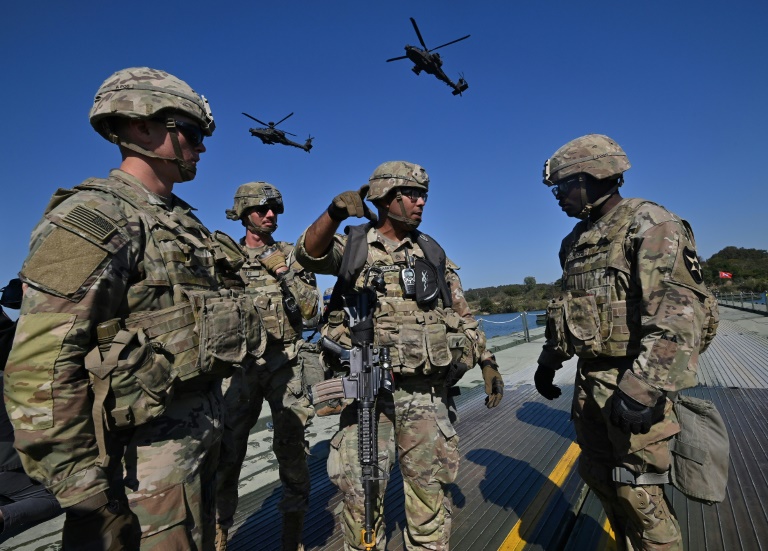
But in order to establish itself as a “benevolent global hegemony”, the U.S. has to keep increasing its massive and unsurpassed military expenditure. The author notes that today, only the U.S. military retains the ability to reach into any region in the world within hours, particularly using the hundreds of U.S. military bases dotting the globe. In 2021, it was estimated that the U.S. had 750 bases spread in 80 countries, in addition to about 173,000 troops deployed in 159 countries.
The U.S. is caught in a self-destructive mode – damned if you, damned if you don’t. The country has created more enemies than friends, and countries now desperately want to free themselves from the hegemony.